Eight months after a 74-year-old woman’s death, police have registered an FIR against two doctors of Landmark Hospital, Sector 33, for medical negligence.
The case has been filed against Dr Harsimran Singh and Dr Parminder Singh under Section 304 A (causing death by negligence) of the Indian Penal Code.
As per the victim Amarjit Kaur’s son, Sukhwinder Pal Sodhi, the septuagenarian had been admitted to Landmark Hospital on March 16, after suffering a femur (leg bone) fracture. He had requested the hospital to use the best available implant, one that was compatible with MRI scans. The surgery was performed by Dr Harsimran Singh, who assured the family that the implant met these standards. However, the patient was discharged the very next day, on March 18, without adequate post-operative care or monitoring.
Fifteen days later, on April 3, Kaur returned to the hospital with symptoms of disorientation. Lab reports indicated critically low sodium levels. Despite this, the doctors did not admit her or take serious action, prescribing only medications and sending her home. The next day, Kaur suffered intense seizures and was rushed to Government Medical College and Hospital (GMCH), Sector 32, where she was admitted to the Medicine ICU and placed on a ventilator.
During her stay at GMCH-32, doctors requested clearance regarding the MRI compatibility of the implant to proceed with further investigations. Despite repeated pleas, doctors at Landmark Hospital refused to provide written assurance.
{{/usCountry}}During her stay at GMCH-32, doctors requested clearance regarding the MRI compatibility of the implant to proceed with further investigations. Despite repeated pleas, doctors at Landmark Hospital refused to provide written assurance.
{{/usCountry}}Dr Harsimran directed the family to his father, Dr Parminder Singh, who also declined to cooperate. On April 4, she had seizures and died 12 days later in the emergency ward of GMCH, Sector 32.
UT medical board findings
Following a complaint by the victim’s son, the UT medical board, chaired by Dr AK Attri, director principal of GMCH Sector 32, investigated the matter. The board, comprising senior medical professionals, found Landmark Hospital guilty of negligence. Key findings included the use of substandard implant, premature discharge, neglect of symptoms, and non-cooperation. The committee stated that supportive documents revealing the advice for admission of patient due to low sodium or refusal for admission by the patient or attendants, was not submitted by the doctors of the hospital to the committee.
After legal scrutiny and opinions from senior officers, including DDA (legal), police registered an FIR under Section 304A Indian Penal Code at Sector 34 police station on December 18. Assistant sub-inspector Bala has taken over the investigation.
Sodhi alleged that the doctors charged ₹50,000 for the implant but used a substandard product. He accused the hospital of engaging in unethical practices and misrepresenting facts to patients. “The negligence of these doctors caused my mother immense suffering and eventually her death. I urge the authorities to cancel the hospital’s licence to prevent other families from going through this ordeal,” said the victim’s son.
Landmark Hospital has yet to issue a statement on the allegations and the FIR.
BOX
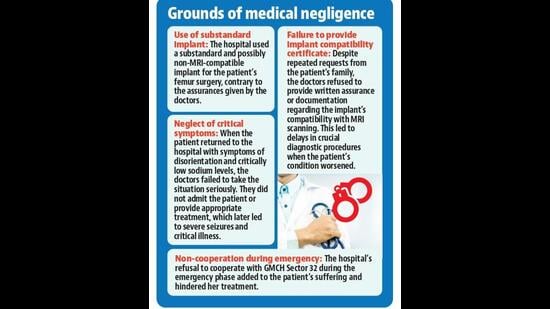
Grounds of medical negligence:
Use of substandard implant: The hospital used a substandard and possibly non-MRI-compatible implant for the patient’s femur surgery, contrary to the assurances given by the doctors.
Failure to provide implant compatibility certificate: Despite repeated requests from the patient’s family, the doctors refused to provide written assurance or documentation regarding the implant’s compatibility with MRI scanning. This led to delays in crucial diagnostic procedures when the patient’s condition worsened.
Neglect of critical symptoms: When the patient returned to the hospital with symptoms of disorientation and critically low sodium levels, the doctors failed to take the situation seriously. They did not admit the patient or provide appropriate treatment, which later led to severe seizures and critical illness.
Non-cooperation during emergency: The hospital’s refusal to cooperate with GMCH Sector 32 during the emergency phase added to the patient’s suffering and hindered her treatment.