Amid concerns of transmission of the new Omicron variant of Covid-19, the Post Graduate Institute of Medical Education and Research (PGIMER), Chandigarh, is unable to conduct whole genome sequencing of positive samples as it is yet to apply to the central government for authorisation.
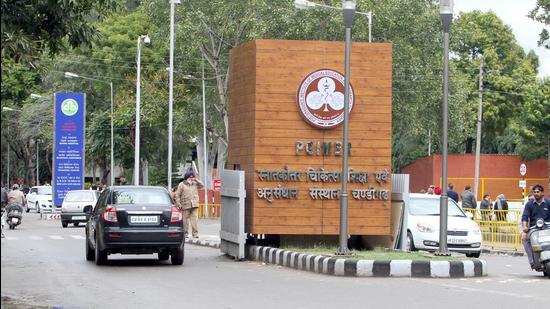
The PGIMER authorities said it will take at least another three months before the institute can officially start the process. Genome sequencing attempts to draw out the complete genetics of the virus and helps identify its variant, which aids timely surveillance and regulatory measures.
Earlier, in July and August, the PGIMER’s department of virology had conducted a pilot project, in which medical experts conducted genome sequencing of some samples. The same samples were sent to other national institutes, and the PGIMER’s results were found matching with their results.
{{/usCountry}}Earlier, in July and August, the PGIMER’s department of virology had conducted a pilot project, in which medical experts conducted genome sequencing of some samples. The same samples were sent to other national institutes, and the PGIMER’s results were found matching with their results.
{{/usCountry}}“We are in the process of applying for the authorisation. It will be done within a month, and the Centre’s authorisation will take another couple of months,” said Dr Mini P Singh, nodal officer for Covid-19 testing at the PGIMER.
Dr Singh said that the PGIMER has an Indian Council of Medical Research (ICMR)-approved lab providing round-the-clock diagnostic services for 1,500 to 2,000 samples since the onset of the pandemic. “Further, we have been a centre of excellence and established more than 75 Covid-19 labs across North India as the mentor lab,” she said.
At present, the PGIMER is sending its samples for genome sequencing to the National Centre for Disease Control, Delhi. Since all states send their samples to the lab, test reports get delayed by over a month. The emergence of Omicron (B.1.1.529), a new variant of concern of Covid-19, has attracted worldwide attention. It is believed to have originated in South Africa in an immune-compromised patient.