Following in the footsteps of Mohali, the Panchkula administration has allowed only a two-hour window for bursting green crackers on Diwali.
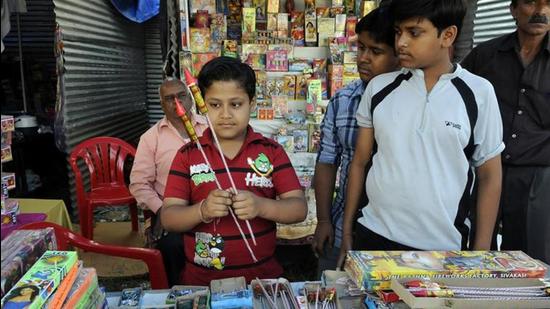
Panchkula district magistrate Vinay Pratap Singh, who issued the orders on Wednesday, said residents can burst green crackers from 8pm to 10pm on Thursday. He said the sale and use of other fire crackers is banned in compliance with a letter issued by the State Disaster Management Authority, Haryana, adding that area-wise teams have been constituted to enforce the order.
In Mohali, too, following the Punjab government’s directions, residents are allowed to burst only green crackers for two hours, 8pm to 10pm, on Diwali. The administration has issued just 40 temporary licences for the sale of crackers across the district.
Meanwhile, the Chandigarh administration on October 12 imposed a banket ban on the sale and use of crackers after extensive consultation with health and environment experts, and has refused to give any relaxation despite petitions from cracker traders.
2,750 cops to enforce orders across tricity
Around 2,750 police personnel in addition to administrative officials will keep vigil to enforce these orders across the tricity. Residents can also call on 112 for reporting any violation.
The Panchkula district magistrate said that air pollution poses serious environmental risks with adverse effects on the health of people, particularly vulnerable sections like children, elderly and people with pre-existing respiratory illnesses.
As many as 1,000 cops will enforce the orders across the district. The district magistrate said violators will be booked under the Disaster Management Act 2005 and Section 188 (non-compliance of prohibitory order) of the Indian Penal Code (IPC).
{{/usCountry}}As many as 1,000 cops will enforce the orders across the district. The district magistrate said violators will be booked under the Disaster Management Act 2005 and Section 188 (non-compliance of prohibitory order) of the Indian Penal Code (IPC).
{{/usCountry}}In Chandigarh, too, anyone caught selling or bursting crackers will be booked under Section 188 of the IPC and relevant sections of the Disaster Management Act. Section 51 of the Act provides for a jail term of two years in case anyone gets hurt and one year for mere violation, while Section 188 entails a jail term up to three months.
To ensure strict compliance, different teams of Chandigarh Police, comprising over 600 cops, have been deployed. About 42 floating nakas will be set up in different parts of the city from 4pm till late at night.
In Mohali, the district police have intensified patrolling, especially on the routes leading to religious places and markets. As many as 1,150 cops in uniform as well as civvies will be on duty, and the violators will be booked under Section 188 of the IPC, said senior superintendent of police Navjot Singh Mahal.
Day before Diwali, air quality turns very poor
Air Quality Index (AQI) went up to 318 at the monitoring station in Sector 22, Chandigarh, around Wednesday noon. It stayed the “very poor” bracket for about two hours before falling into 100s once again.
As the AQI at the other continuous ambient air quality monitoring station in Sector 25 remained under 100 (satisfactory) throughout the day, the officials are calling the spike at Sector 22 an “anomaly”.
Ruling out the role of stubble burning, Chandigarh Pollution Control Committee member secretary Debendra Dalai said: “Since the AQI went back into 100s in just a couple of hours, it was most likely an anomaly. Any spike due to stubble burning or temperature changes would have kept the AQI high throughout the day.”
Dalai said the AQI on an average was a bit higher on Wednesday due to vehicular movement amid festive rush. The Chandigarh administration has imposed a blanket ban on the sale and use of crackers to combat pollution.
According to government agencies, an AQI within the range of 0-50 is regarded as good, 51-100 is satisfactory, 101-200 is moderate, 201-300 is poor, 301-400 is very poor and 401-500 is severe. If “very poor”, the polluted air can cause respiratory illness on prolonged exposure.
Meanwhile, clear and dry weather is likely to continue in the city, according to the India Meteorological Department (IMD). In the next three days, maximum temperature will remain around 30-31°C and minimum temperature around 13°C.