The Commission for Air Quality Management (CAQM) has issued notices to deputy commissioners (DCs) and senior superintendents of police (SSPs) of six districts in Punjab, seeking explanations for alleged non-compliance with its directions to prevent and control paddy stubble burning during the ongoing harvesting season.
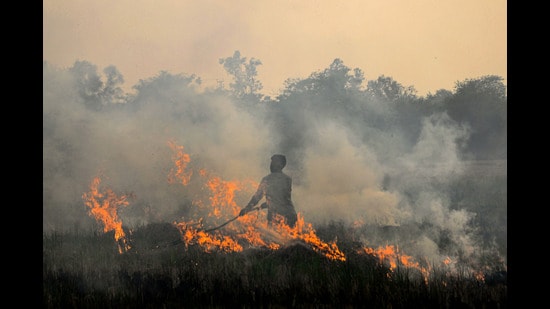
The CAQM has sought explanation from the DCs and SSPs of Sangrur, Patiala, Sri Muktsar Sahib, Moga, Mansa and Ludhiana by November 23.
Earlier, eight other districts were issued same notices for non-compliance with the commission’s directives.
The state recorded 6,718 cases of stubble burning till November 18 this year, against 5,018 last year.
The officers have been directed to explain why action should not be initiated against them under Section 14 of the Commission for Air Quality Management in National Capital Region and Adjoining Areas Act, 2021, for non-compliance with or contravention of the commission’s orders and directions.
Under Section 14 (penalty for contravention of provisions of Act, rules, order or direction) of the Commission for Air Quality Management (CAQM) Act, an official, if found guilty, may face a jail term of up to five years and fine up to ₹1 crore. The act mentions that this punishment shall, however, not be applicable to any farmer.
In its communiques issued by CAQM member secretary Tarun Kumar Pithode, the commission said it was noticed that there were paddy stubble burning incidences that were not recorded through standard protocol.
{{/usCountry}}In its communiques issued by CAQM member secretary Tarun Kumar Pithode, the commission said it was noticed that there were paddy stubble burning incidences that were not recorded through standard protocol.
{{/usCountry}}For addressing such issues, the commission has time and again stressed on stringent supervision through drones, parali protection force, nodal officers, low-cost sensors, strict implementation and rigorous enforcement of the Action Plan to achieve complete elimination of paddy stubble burning.
“Despite above noted review meeting and statutory directions issued by the commission to ensure complete elimination of paddy stubble burning during 2026, it has been noticed that paddy residue burning events are reported to have increased in certain districts of Punjab comparing to previous year which indicates that adequate supervision, effective implementation and enforcement of the action plan to eliminate paddy stubble burning has not been forthcoming,” the notices stated.
In Sangrur, during the period from September 15 to November 16, 2026, 741 farm fire incidents were reported in Sangrur, as against 694 incidents during the corresponding period in 2025. Patiala district reported 416 farm fire incidents against 233 cases till date last year, while Moga recorded 346 stubble burning cases than 327 last year. Ludhiana district reported 351 cases till November 16 against 208 on the same date last year. Muktsar recorded 271 cases this year so far against 352 last year, while Mansa reported 253 stubble burning incidents against 292 last year.
The notices followed a review of stubble-burning incidents in Punjab, during which the commission observed an increase in reported farm-fire incidents in several districts compared with the corresponding period last year, raising serious concerns over the enforcement of preventive measures and accountability at the district level.
“The commission held meetings with the officials of the government of Punjab and the DCs on October and November to review measures being undertaken to prevent and control incidents of paddy stubble burning and emphasised on the importance of stringent enforcement and proactive measures during the ensuing harvesting season to prevent and control the incidences of stubble burning but no required action has been taken,” the commission said.
CAQM already directed use of drones to identify stubble burning cases
Before the start of paddy harvesting, the CAQM had already directed the state government and the Punjab Pollution Control Board (PPCB) to ensure drone surveillance in identified stubble burning hotspots.
The CAQM said that undetected late-evening burning demanded tighter surveillance through unmanned aerial vehicles (UAVs). “The alleged practice of burning paddy stubble in late evening hours to evade satellite tracking calls for a strengthened surveillance mechanism. UAVs will enable timely detection and enforcement,” the CAQM directive said.
The commission mandated that drone surveys operate during the day, with focus on late evening hours—specifically targeting the 3 pm to 9 pm window. UAVs will map active fires and burnt traces against local cadastral maps, ensuring lawful, safe, and systematic geo-tagging and documentation.