With the festive season drawing more shoppers to markets, pedestrians in Panchkula are being forced to walk on busy roads or squeeze through parking spaces because footpaths remain occupied by street vendors, shopkeepers and even residents. From crowded commercial hubs to residential sectors, encroachments and damaged pathways have made walking increasingly difficult and unsafe.
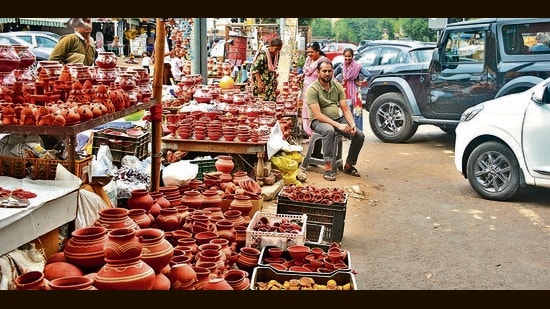
In major markets, several shopkeepers have extended their display areas beyond their showrooms, placing goods in corridors and on pavements. Street vendors have also occupied stretches of footpaths, leaving little room for pedestrians. The problem is particularly visible in Sectors 11, 14 and 15, where shoppers and commuters often have to negotiate their way through congested spaces or walk on roads.
The problem is not confined to markets. In residential sectors, residents have allegedly turned footpaths into parking spaces for cars and two-wheelers, while some have extended their green cover onto pedestrian pathways.
The situation persists despite a significant Supreme Court ruling in June this year. While hearing a motor accident compensation case, the apex court held that the right to walk on a demarcated footpath is a fundamental right and must take priority over motorised vehicles. It said the right forms part of the freedom of movement under Article 19(1)(d) and the right to life and liberty under Article 21. The court also emphasised that urban development authorities, municipal bodies and panchayats must demarcate, construct, maintain and protect footpaths and other pedestrian infrastructure.
Four months after the ruling, however, several footpaths in Panchkula remain encroached upon or damaged. Residents have questioned the lack of sustained enforcement and called for action against illegal vendors, pointing to neighbouring Chandigarh, where authorities take action against such encroachments.
{{/usCountry}}Four months after the ruling, however, several footpaths in Panchkula remain encroached upon or damaged. Residents have questioned the lack of sustained enforcement and called for action against illegal vendors, pointing to neighbouring Chandigarh, where authorities take action against such encroachments.
{{/usCountry}}RP Malhotra, president of the Federation of Residents’ Associations, said he had written to the chief administrator of Haryana Shehri Vikas Pradhikaran (HSVP), the director general of urban local bodies, the municipal corporation (MC) commissioner and the chief executive officer of Panchkula Metropolitan Development Authority (PMDA), seeking protection of pedestrians’ fundamental rights. He claimed that he had received no response. He also sought a comprehensive survey of footpaths to identify encroachments, unauthorised structures, parked vehicles and other obstructions.
Rakesh Aggarwal, a member of Panchkula Vikas Manch, said he had also approached the authorities soon after the Supreme Court ruling, but no effective action had followed. He said footpaths in both market and residential areas were being used for purposes other than pedestrian movement.
Deputy commissioner Satpal Sharma said an anti-encroachment drive had been carried out earlier and would be conducted again soon to clear footpaths and areas outside showrooms.
MC commissioner Vinay Kumar said a 2017 survey had identified around 3,700 street vendors, but many had since shifted or stopped vending. Their present number was estimated at 1,700 to 1,800, he said. Around 7,000 to 8,000 vendors had also been registered under the National Urban Livelihoods Mission (NULM). The MC regularly monitors illegal vending and takes action through its enforcement staff. It is also planning a fresh survey of street vendors, he added.