For centuries, artisans in Kashmir used waste paper to create world-famous paper-mâché art. Now, a new experiment by a woman artisan and her mentor in Srinagar has changed the craft’s core ingredient—paper—replacing it with aquatic weeds with excellent results.
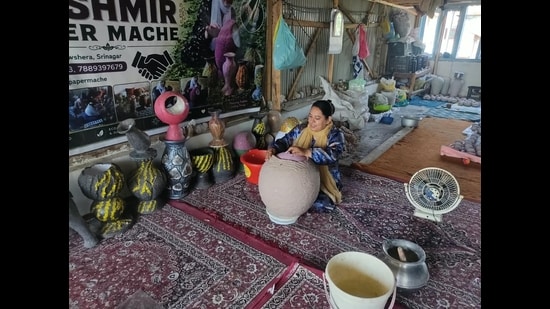
After experimenting with various land grasses and waterweeds for more than two years, 35-year-old Simran Irshad and her teacher, 50-year-old Mohammad Yousuf—both residents of the Old City—have successfully crafted this art form using weeds extracted from Dal Lake. This innovation helps shield their work from rising scrap costs and the dwindling supply of paper caused by the digital shift in the print industry.
The initiative has raised hopes that this can help clean the lake, which has been choked with an unwanted growth of underwater weeds and lily pads owing to sewage pollution. Simran, a resident of Nowshahr, said that this started a few years back when there was a push across the country for Digital India and online classes.
“When the Digital India wave became prominent, we wondered what would happen to our art if ‘paper’ vanished. The cost of paper scrap, our main raw material, had already gone up. Even schools were using online classes. This art is not only providing us with employment, but this is also our identity and we didn’t want this craft to die,” she said.
{{/usCountry}}“When the Digital India wave became prominent, we wondered what would happen to our art if ‘paper’ vanished. The cost of paper scrap, our main raw material, had already gone up. Even schools were using online classes. This art is not only providing us with employment, but this is also our identity and we didn’t want this craft to die,” she said.
{{/usCountry}}Paper-machie is traditionally made using paper pulp which is spread over wooden moulds and then painted with rich colours by another set of artists.
The paper pulp is made from scrap paper which is first soaked in water and then beaten in a mortar using a wooden pestle. The paper paste is then given different shapes on a mould and dried in the sun. The raw moulded objects are then given a super finish by artists using various metal tools and then finally another set of artists paint the products with different colors and motifs.
Paper-mâché products traditionally comprise vases, table lamps, boxes, trays, replicas of animals and birds and Christmas decorations. Simran and Yousuf experimented with weed and grass replacing the paper scrap or mixed it together to get the desired result as the weed was readily available in Dal Lake.
Yousuf said, “The cost of paper scrap has increased to ₹2,500-3,500 per quintal from ₹500-700 per quintal some five to six years ago. Craft dies as its raw material becomes expensive. After digital news and social media expansion, newspapers, which we use as scrap, have reduced their print. Overall costs have also increased. But here, the weed from Dal Lake is abundant and free of cost,” he said, adding that the initiative, if mimicked at a large level, will help the environment as well.
“Paper comes from trees which obviously affect the environment. We should help save the environment and if weeds are extracted from Dal Lake, its pollution will also decrease,” he said.
Simran said they had a Eureka moment in 2023 when they were in a park where a gardener was cutting grass. “We were thinking about how the art could be made without paper in a park when Yousuf brought a handful of grass and said ‘let’s try this’,” she said.
“After that, we tried different varieties of grass, tree leaves and finally settled on normal water weed and lily pads from Dal Lake. Every grass can work but waterweed and lily pads have good moisture and are good. Only after successfully working on these, we made the discovery public,” she said.
Papier-mâché art is said to be brought to the Valley by Persian Muslims in the 15th century and is a treasured handicraft variety of Kashmir. The art is believed to have entered Kashmir after sufi saint Mir Syed Ali Hamadani brought many artists with him and taught this art to Kashmiris. Some 3,000-3,500 artisans make paper-mache in the city.
Simran said she learned the art from Yousuf, even though she had been doing Pashmina work since childhood. “There are not many women who make moulds for paper-mache. When he agreed to teach me, he faced a lot of backlash, with many men telling him, ‘you have brought women into the industry’, but he didn’t budge and taught some 60 artisans—54 of them were women,” she said.
She said that, after the good press they got, many people have approached them to learn at their workshop in Zoonimar. “We train people. Students are also coming but we don’t have enough space at our workshop,” she said.
“We can use weed at mass scale only if there is enough space and institutional support from the handicrafts department and Indian Institute of Craft and Design,” she added.