Punjab has deleted 2,89,334 ration cards under the National Food Security Act (NFSA), 2013, between 2021 and 2025, according to data tabled by the Union ministry of consumer affairs, food and public distribution, in the Lok Sabha on Wednesday.
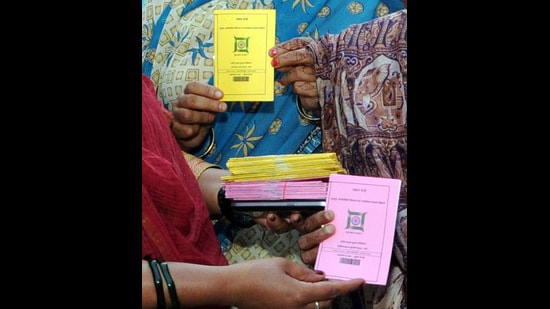
The figures, provided in response to a question by MP Shivaji Bandappa Kalge, show that ration-card deletions in Punjab peaked at 1,52,497 in 2022, followed by 1,23,722 in 2023. The deletions subsequently dropped sharply to 7,520 in 2024 and 2,290 in 2025, compared with 3,305 in 2021.
Punjab has 1.52 crore NFSA beneficiaries, with 40,93,003 ration cards, according to data from the Central NFSA repository cited by the Union government. The current NFSA Punjab dashboard lists 40,47,613 ration cards, comprising 1,77,929 Antyodaya Anna Yojana (AAY) cards and 38,69,684 Priority Household (PHH) cards.
In Punjab, AAY households are entitled to 35 kg of foodgrains per household per month, while PHH beneficiaries receive 5 kg per person per month. The foodgrains are currently provided free of cost.
Across the country, the government reported deletion of more than 2.24 crore ration cards during the five years. The annual figures stood at 29,02,794 in 2021, 63,80,274 in 2022, 41,99,373 in 2023, 48,85,259 in 2024 and 41,41,385 in 2025.
{{/usCountry}}Across the country, the government reported deletion of more than 2.24 crore ration cards during the five years. The annual figures stood at 29,02,794 in 2021, 63,80,274 in 2022, 41,99,373 in 2023, 48,85,259 in 2024 and 41,41,385 in 2025.
{{/usCountry}}The data assumes significance amid concerns over the impact of digital authentication and verification mechanisms on access to subsidised foodgrains. The Lok Sabha question specifically sought details on biometric authentication failures, server downtime and other digital glitches that could result in eligible beneficiaries being denied or facing delays in receiving their ration.
The Centre, however, said multiple authentication mechanisms—including single-finger, fusion-finger, iris and Aadhaar-based OTP authentication—had been provided under the Public Distribution System (PDS).
The ministry said that if authentication by one household member failed, other eligible members linked to the ration card could authenticate and collect the foodgrains. A nominee facility was also available in exceptional cases, allowing beneficiaries to authorise another person to lift their ration.
The government further said e-PoS devices at fair price shops could operate in offline mode in areas with limited or no internet connectivity, with transactions subsequently synchronised with the PDS network. States and Union Territories had also been advised that no genuine beneficiary should be denied subsidised foodgrains because of biometric or Aadhaar authentication failure, connectivity or linking problems, technical issues or poor biometrics.
On whether the government had assessed the impact of authentication and exclusion-related errors on marginalised communities, the ministry said the Department of Food and Public Distribution had conducted a concurrent evaluation of the Pradhan Mantri Garib Kalyan Anna Yojana (PMGKAY) during 2025-26 to strengthen monitoring and generate empirical evidence on the implementation of the food security programme.