The Haryana Saraswati Heritage Development Board has intensified efforts to bring back an ancient 11th-century idol of Goddess Saraswati from the British Museum in London to India.
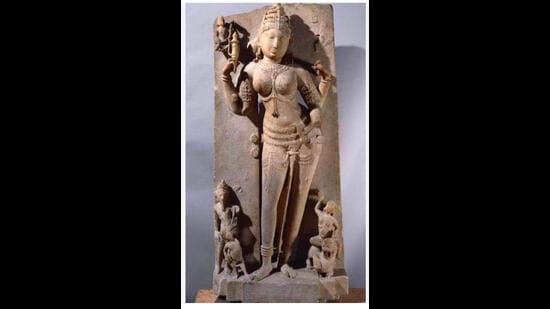
According to the board, the idol originally belongs to the historic Bhojshala Temple in Dhar, Madhya Pradesh, and the British took it to England, during the colonial era during 1886–1891.
Board’s deputy chairperson Dhuman Singh Kirmach said they established formal contact with the Madhya Pradesh government regarding this matter and apprised Haryana chief minister Nayab Singh Saini through correspondence.
“The board’s objective is to bring the idol to India, display it in regions associated with the Saraswati civilisation, and ultimately install it in the Saraswati Museum in Haryana. It is a heritage piece of immense antiquity and religious and cultural significance, embodying Goddess Saraswati as the symbol of knowledge, learning, and culture. Currently, the idol is housed in the British Museum in London,” he said.
Kirmach said that recently the Indore Bench of the Madhya Pradesh high court issued a significant order recognising the Bhojshala complex as the ancient Saraswati Vagdevi Temple and granting the Hindu community the right to worship there.
In light of this development, the demand to bring this historic idol back to India has become even more relevant, he said.
{{/usCountry}}In light of this development, the demand to bring this historic idol back to India has become even more relevant, he said.
{{/usCountry}}“Under the leadership of Prime Minister Narendra Modi, the Government of India is running a campaign to repatriate India’s ancient cultural and religious heritage from abroad. The return of numerous rare idols and artifacts from various countries over the past few years has further strengthened this initiative,” he said.
Citing historical records, the board said that the idol dates back to the Paramara dynasty era (11th century) and British officials recovered it during archaeological excavations in the Dhar region.
Two idols were discovered at that time; one is currently installed at the Bhojshala, while the other is in London.
Explaining the idol’s significance, Kirmach said that they were made of marble and bear inscriptions in Sanskrit and Devanagari.
“If the statue is brought back to India, in-depth research will be conducted on these inscriptions, potentially yielding new information about our ancient civilisation, the Saraswati river, and the associated cultural heritage,” he said.
The board is also planning to develop a Saraswati Museum in Kurukshetra and has also identified two locations in the holy town to attract commuters travelling on the NH-44.
He said that the state government has been making efforts to promote Kurukshetra as a religious tourism hub and as part of this, the board will spend the budget on the museum’s development.
“According to the initial plan, the museum will have sculptures, maps and other archaeological remains, besides the research work conducted by the KUK’s Centre of Excellence for Research on Saraswati river,” Kirmach said.