Haryana appears to be making an early breakthrough in its battle against paddy stubble burning, with the state recording just four farm-fire incidents till October 3, even as the paddy harvesting season gathers pace.
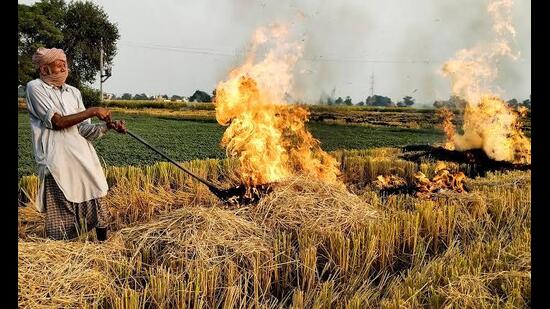
According to the latest data of consortium for research on agroecosystem monitoring and modeling from space (CREAMS) laboratory at the Indian Agricultural Research Institute (IARI) tracks daily paddy residue burning events across key Indian states using polar-orbiting satellite sensors. A total 218 burning events were detected in the six states between September 15 to October 4, Punjab has witnessed the highest 79 incidents followed by 70 in Madhya Pradesh, 59 in Uttar Pradesh and 4 each in Haryana and Rajasthan and one each in Delhi and Uttarakhand.
Last year Haryana reported seven paddy residue burning events during the same period, which shows around 50% decline than the last year. While Punjab reported 97 such incidents during this period last year.
According to the ground level officers and farmers, the sharp decline is not merely the result of enforcement. An emerging market for paddy straw is giving farmers an incentive to remove the residue from their fields instead of setting it on fire and quick ex-situ management of the millions of tonnes of the crop waste with highly subsidised machines is the another key factor behind why the farmers left burning the crop waste.
{{/usCountry}}According to the ground level officers and farmers, the sharp decline is not merely the result of enforcement. An emerging market for paddy straw is giving farmers an incentive to remove the residue from their fields instead of setting it on fire and quick ex-situ management of the millions of tonnes of the crop waste with highly subsidised machines is the another key factor behind why the farmers left burning the crop waste.
{{/usCountry}}In several parts of Haryana, private operators are now entering fields with balers, collecting the straw and transporting it to industries that use it as biomass fuel or raw material.
This year a new straw-collection business has emerged in villages that were once considered stubble-burning hotspots. The operators have deployed tractors and cover thousands of acres a day, transporting bales to factories involved in bottling, cardboard and dyeing, among other industries. Sachin Kumar a farmer from Yamunanagar, who have started the crop waste business this year said, “I have procured crop straw of around 200 acres so far. We have a long list of farmers waiting for their turn to get their crop waste. There is a huge demand for the paddy residue waste due to setting up of the several plants which convert crop waste into dense, high-energy fuel pellets”
“Strict enforcement and incentives have helped reduce such incidents significantly in recent years. The practice could be further curbed if Haryana and Punjab fully implement their 2018 orders mandating SMS-equipped combine harvesters and provide a ₹2,000-per-acre incentive for farmers who incorporate stubble into the soil through deep ploughing. This would also improve soil fertility and provide an environmentally sustainable solution”, said Virender Singh Lather, former principal scientist at ICAR-Indian Agricultural Research Institute New Delhi.
Haryana agriculture and farmers welfare minister Shyam Singh Rana said, “Farmers in the state are increasingly moving away from crop residue burning as a market for crop waste has emerged. The government is also strengthening the supply chain to connect farmers with industries. Farmers should come forward and avail themselves of these schemes to help make Haryana stubble-burning free.”
Experts say paddy stubble burning usually peaks in the first half of November, when farmers face a narrow window between harvesting paddy and sowing wheat. However, officials are confident that Haryana will achieve significant progress in curbing stubble burning this year. According to the state agriculture department, Haryana expects to generate around 80 lakh metric tonnes (LMT) of paddy residue from nearly 16 lakh hectares under paddy this kharif season.