The statewide sanitation workers’ strike completed 30 days on Friday with no sign of a breakthrough, as protesting employees intensified their agitation by shaving their heads to protest government notices threatening dismissal for failing to return to duty.
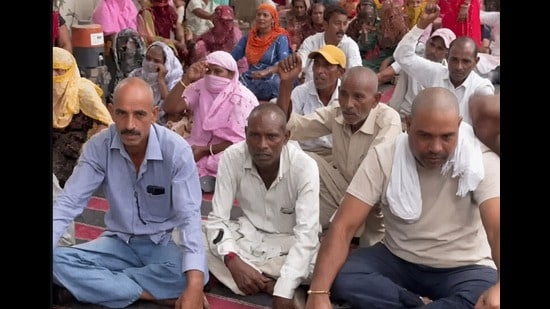
Even as the state government’s September 5 return-to-work order has had no visible impact so far as sanitation workers stay off duty, as around 13,000 protesting sanitation workers made it clear that they will not end the strike until their demands are accepted.
On Friday, the striking employees began a head-shaving protest, giving a message to the government as a response to what they termed “intimidation” and attempts to force workers back through punitive measures rather than resolving their demands.
The urban local bodies (ULB) department has directed sanitation workers and sewermen who have remained absent since August 6 to resume duty by 9am on September 5.
The department termed sanitation an essential service and warned that employees failing to comply could face departmental and legal action. The directorate of ULB also directed municipal authorities across the state to outsource sanitation operations in place of striking or absent employees and ensure adequate manpower, machinery and equipment through authorised agencies.
Even the municipal corporation commissioners and district municipal commissioners have been asked to ensure strict implementation of the order stating that sanitation is an essential service and one of the primary responsibilities of ULB. It also cited provisions of Haryana Municipal Act, 1973, and Haryana Essential Services Maintenance Act, 1974, to underline the need to maintain sanitation services.
{{/usCountry}}Even the municipal corporation commissioners and district municipal commissioners have been asked to ensure strict implementation of the order stating that sanitation is an essential service and one of the primary responsibilities of ULB. It also cited provisions of Haryana Municipal Act, 1973, and Haryana Essential Services Maintenance Act, 1974, to underline the need to maintain sanitation services.
{{/usCountry}}The government cited an August 18 Punjab and Haryana high court order mentioning that sanitation equipment and machinery were damaged during the agitation, with FIRs registered in some cases.
However, the directive has failed to make any visible impact on the strike, with unions maintaining that workers will remain off duty.
The employees had already extended the agitation till September 6 and announced plans to gherao the camp office of ULB minister Vipul Goel in Faridabad and other ministers and MLAs of the ruling party from September 5.
The strike, which began on August 6 as a three-day protest, followed the failure to implement in writing the assurances contained in the May 13 agreement that had ended an earlier strike. It has since expanded into a statewide shutdown involving sanitation workers, sewermen and fire personnel working with municipal corporations, councils and committees.
The prolonged strike has led to the accumulation of garbage in several urban centres, including Rohtak, Hisar, Sonepat, Bahadurgarh, Jhajjar and Sirsa. Civic authorities have deployed alternative workers, machinery and police personnel to clear waste, resulting in confrontations at several places. Police cases have been registered against workers following clashes during attempts to remove garbage.
The government has also adopted a tough approach against striking fire employees. A total of 24 workers have been dismissed, including 14 contractual employees and 10 engaged through the Haryana Kaushal Rozgar Nigam (HKRN). Earlier, 14 permanent fire brigade employees were suspended and more than 1,200 fire personnel were issued notices to resume duty.
In Rohtak, sanitation and fire employees accused the government of deliberately trying to break the strike and create divisions among workers. Municipal Sanitation Employees Union district president, Shambhu Tank, alleged that the administration was using coercive tactics instead of addressing employees’ grievances.
Tank said the government had promised regularisation of contractual employees in its election manifesto but failed to fulfil the commitment. He alleged that attempts were being made to impose unilateral decisions on workers to weaken the agitation.
The unions’ principal demands include regularisation of contractual sanitation and fire employees, abolition of the outsourcing system and written implementation of the May 13 agreement. They are also seeking minimum wages, risk allowance, ESI and EPF benefits, compassionate appointments, compensation in sewer deaths and reinstatement of retrenched workers.
On the other hand, the government maintains that several demands have already been accepted in principle. It stated that 12 of the 13 demands were addressed during six rounds of talks, including uniform allowance, equal pay for equal work with arrears for eligible workers, LTC, ESI and EPF and a ₹2,000 monthly risk allowance. Officials have also offered protection under the Haryana Contractual Employees (Assurance of Service) Act, 2024, and continuity of service up to 60 years.
The union leaders insist that verbal assurances are not enough and want formal written orders implementing the agreement.