The absence of a dedicated state-level regulatory body or commission for the Right to Information (RTI) Act, 2005, has eroded the legislation’s effectiveness in Chandigarh. Designed to empower citizens to seek details on government budgets, expenditure, project status, and annual performance, the law is increasingly being reduced to a paper tiger.
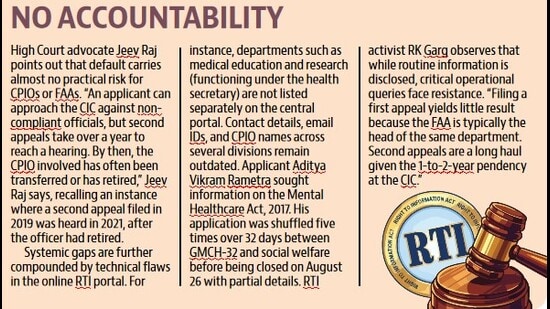
Unlike states with dedicated State Information Commissions (SICs), Union Territories like Chandigarh rely on the Central Information Commission (CIC) in New Delhi as their second and final appellate authority. Responding to the structural gap, the office of the home secretary, Chandigarh, said: “Chandigarh is a UT without a legislature. Under the Right to Information Act, 2005, jurisdiction over all central public authorities and UTs lies entirely with the Central Information Commission, New Delhi. Deciding to establish a separate SIC rests with the ministry of home affairs. However, we are actively strengthening the internal first appellate mechanism to ensure timely resolution for citizens.”
Despite these assurances, an analysis of multiple RTIs filed across departments reveals a recurring pattern of delayed responses, incomplete answers, and non-compliance with statutory deadlines.
Sections 7(1) and 19(6) of the Act require Central Public Information Officers (CPIOs) and First Appellate Authorities (FAAs) to respond within 30 days. First appeals may extend to 45 days only if written reasons for delay are recorded.
{{/usCountry}}Sections 7(1) and 19(6) of the Act require Central Public Information Officers (CPIOs) and First Appellate Authorities (FAAs) to respond within 30 days. First appeals may extend to 45 days only if written reasons for delay are recorded.
{{/usCountry}}In practice, these timelines are regularly flouted:
Health department: In an appeal concerning brain stroke patient admissions and transfers from GMSH-16 to PGIMER over the past decade, the CPIO claimed on the 36th day that “no such report is available.” Following a first appeal, FAA Dr. Suman Singh provided the data after 107 days—offering no explanation for the delay.
UT estate office: An appeal filed with Estate Officer Nishant Kumar Yadav remained unanswered after 85 days.
Social welfare department: Seeking seat allocation details at the Sector 31 Group Home for mentally ill persons, an applicant was told the department lacked data. Under Section 6(3), the authority was required to transfer the request within five days; instead, it simply closed the file.
Rejections and pendency
The CIC Annual Report for 2024–25 shows that out of 12,457 RTI applications filed in Chandigarh, replies were provided for 9,900. A total of 1,568 appeals remained pending (with 200 scheduled for hearings), marking a 13% pendency rate.
Of the total applications, 745 (3%) were rejected. Significantly, 83% of these rejections cited Section 8 exemption clauses, with 157 applications turned down under Section 8(1)(j) on grounds of “personal information.”
Former Punjab chief information commissioner Ramesh Inder Singh said that the regulatory mandate is often misunderstood: “Central or state information commissions are quasi-judicial bodies whose primary role is to hear second appeals and penalize violating CPIOs. The primary responsibility to enforce the Act rests with the government; the commission plays an advisory role.”
Advocate HC Arora, who has filed over 400 PILs in the Punjab and Haryana high court and participated in the early 2000s RTI Activist Federation, added: “There is no local agency ensuring the Act is enforced. Neither central nor state governments prioritise its implementation, revealing a systemic loophole.”