With reputation as a fierce and nimble critic of the ruling Aam Aadmi Party, Partap Singh Bajwa, 69, is the most seasoned Congress leader in Punjab who has been in the Vidhan Sabha, Parliament (both Lok Sabha and Rajya Sabha) and minister in the cabinet of four chief ministers. The upcoming assembly polls will be a crucial test for the party’s power sweepstakes as well as his barely concealed ambition: chief minister’s post. At the Leaderspeak@HT session on Tuesday, moderated by Executive Editor Ramesh Vinayak, Bajwa shared his views and vision on Punjab, peppering a 90-minute lively conversation with his trademark wisecracks. Edited excerpts:
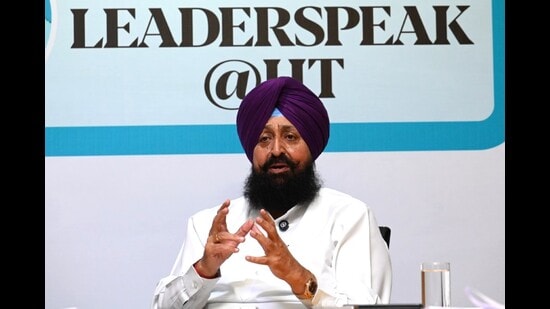
How do you read Punjab’s current political landscape and the shape of the contest for the 2027 assembly elections?
In 2022, after traditional parties failed, Punjabis believed Arvind Kejriwal’s promises and gave the Aam Aadmi Party a massive mandate. Today, they feel completely cheated. Kejriwal and (chief minister) Bhagwant Mann have failed on every front—law and order, drugs, and debt reduction. In fact, AAP leaders are modern-day dacoits who looted Punjab with impunity. Employees, farmers, and the common man are all unhappy. The AAP will vanish the moment the model code of conduct comes into force. Meanwhile, the Shiromani Akali Dal is in disarray, and the BJP simply does not resonate with Punjabis. The Congress is the only credible alternative left. If there is no SAD-BJP alliance, the Congress will have a field day.
What is your assessment of Bhagwant Mann’s performance as CM?
{{/usCountry}}What is your assessment of Bhagwant Mann’s performance as CM?
{{/usCountry}}He has failed totally. Punjab has seen legendary chief ministers like Partap Singh Kairon and Gurmukh Singh Musafir. Now we have a CM who turns up inebriated in the assembly. Mann brought no vision to Punjab; he simply signed off on whatever Kejriwal and Delhi AAP leaders approved. Kejriwal and he promised ₹20,000 crore from mining and ₹40,000 crore annually in capital expenditure by curbing corruption, but delivered nothing. Instead, the CM ran up Punjab’s debt from ₹2.5 lakh crore to ₹4.5 lakh crore. People are regretting their vote.Once the election code is enforced, the AAP will crumble like the World Trade Center towers. Their MLAs and leaders have already started deserting the ship. That number will touch 35 in the coming days.
The BJP is pushing hard in Punjab, promising a double-engine government. How serious a challenge are they to the Congress?
The BJP is selling pipedreams of eradicating drugs by December 31, 2029, bringing industry, and fixing state finances. What stopped Amit Shah and the BJP for 13 years? As Union home minister, Shah controls the Border Security Force, National Investigation Agency, and Narcotics Control Bureau—why didn’t he act? Who stopped them from announcing a fiscal package for Punjab? Nationally, the BJP wins by polarising voters on communal lines, but Punjabis are too smart for that. In the 2024 Lok Sabha polls, Punjabi Hindus voted for the Ram Mandir, but returned to the Congress in the municipal corporation elections because they know the Congress has true credibility here. Look at Captain Amarinder Singh—he lost miserably on his home turf after joining the BJP. The BJP has a zero chance in Punjab.
If that is true, why are AAP MLAs joining the BJP instead of the Congress?
We have no room for tainted leaders. The BJP lacks local leadership entirely, so they are inducting the condemned stuff just to bargain with the Akalis by showing they have candidates for every seat. No credible face is joining the BJP.
How would a revival of the SAD-BJP alliance alter the contest?
Everyone knows it was the BJP that splintered the SAD into factions. The Akalis broke off the alliance over farmers’ issues and Bandi Sikhs, and the BJP has done nothing on either issue since. What will Sukhbir Singh Badal tell voters now if he aligns with them again? How will the BJP carry the SAD’s baggage over the sacrilege incidents? And what face will Kunwar Vijay Partap show when his party, the BJP, ties up with Sukhbir—whom he personally indicted for sacrilege?
The Akalis have lost their traditional vote bank to Waris Punjab De, and the youth have abandoned them. Even if they align, voters will reject them. The BJP has done nothing for Punjab except turn it into a landlocked state by shutting our trade route to Eurasia through Wagah.
What will be the Congress’ key campaign issues?
Drugs, law and order, gangster culture, and restoring Punjab’s fiscal health. We will present a manifesto that directly reflects the aspirations of Punjabis.
The Congress ruled Punjab for five years right before the AAP. Why should voters give your party another chance when many of these issues persisted under your watch?
I admit Capt Amarinder Singh failed to deliver in his second tenure, and taking an oath on the Gutka Sahib without delivering was wrong—there was no need for such an oath. But Punjabis have since tested the AAP; the SAD is irrelevant, and the BJP has failed. The Congress remains the only credible alternative with a proven track record on development, law and order, and social harmony.
The Congress recently replaced Amarinder Singh Raja Warring with Pargat Singh as Punjab Congress president, yet factionalism persists. Why so?
Every party faces internal friction. The BJP is split between Ashwani Sharma and Kewal Singh Dhillon; Akalis are divided by factionalism. But the Punjab Congress is now united under Pargat Singh. Our leaders realise it is time to fight as one to form the government.
Could this internal friction have been handled better earlier?
Raja Warring rubbed several leaders the wrong way in his hurry to get to the top post. I advised him using my own experience from 2015, when I relinquished the state Congress presidency for Captain Amarinder Singh because he was senior and capable of bringing the party back to power. Today, all of that is behind us. The party is united under Rahul Gandhi’s leadership.
What is your advice to the party leadership ?
Give the green light to 50% of our candidates immediately so they can hit the ground running. The remaining tickets should also be finalised well in advance to give candidates adequate time to campaign. Timely ticket distribution is crucial.
Drugs remain a central issue for the third straight election. Will the Congress offer a timeframe to eradicate the menace ?
You can’t put a rigid deadline on a deep-rooted issue. What it takes is absolute political will, because massive money is involved and parts of the police force are complicit in the nexus. Once you crack down hard on the kingpins supplying synthetic drugs, the problem will largely be resolved. I am committed to doing exactly that.
You have repeatedly accused the AAP government of massive corruption. Will a future Congress government investigate these claims?
I give you my word: Whoever becomes chief minister in a Congress government, we will setup a judicial inquiry commission into the acts of omission and commission by the AAP regime. We will nail everyone involved in this loot. The BJP is playing games using the Enforcement Directorate by seizing files and sitting on them. The Congress will run a parallel, transparent inquiry alongside ED’s probes.
Punjab’s economy is struggling, with heavy spending locked into subsidies. How will the Congress restore fiscal health without cutting welfare schemes?
All welfare schemes and subsidies will continue. The key is driving fresh investment and reopening the Wagah border for trade. I will personally ask the Prime Minister why Punjab is being discriminated against by keeping Wagah closed. If the Union government refuses to open trade, they must grant Punjab a tax holiday as a landlocked border state. Once law and order is restored, investments will flow naturally.
What is your assessment of Waris Punjab De and its electoral prospects?
That hinges largely on the BJP. If the BJP aligns with SAD (Badal), the Election Commission may not grant registration or a common symbol to Waris Punjab De. Without official recognition and a unified symbol, they will struggle to project themselves as a cohesive political force across constituencies.
Why are the Punjab elections so crucial for the Congress?
The nationwide revival of the Congress will begin with a victory in Punjab. It is the only state in the country where a religious minority forms the majority. The BJP usually wins states by engineering communal tensions, but that strategy will not work here. Punjabi Hindus are deeply secular and nationalist.
But state revival hinges heavily on the Union government for things like opening the Indo-Pak border and securing a fiscal package. How will a Congress CM navigate that with the BJP at the Centre?
A credible chief minister who has the guts to stand up and take matters to the Centre can resolve these issues. I’m confident I can convince the Prime Minister on Punjab’s genuine demands. A strong Punjabi diaspora can effectively push our case with the PM. If he still fails to accede to Punjab’s legitimate demands, then we only have to wait until 2029, when Rahul Gandhi will lead the country, as his vision is strongly resonating with the youth and the public. But the real question is: Why is the Centre discriminating against Punjab in the first place? That is a question the BJP needs to answer.
The BJP is actively courting Dalit voters and Dera followers in Punjab. Won’t that hurt the Congress?
Dalit voters do not trust the BJP. They know the RSS inherently opposes Dalit advancement. Recent incidents, like the Haldwani controversy, have clearly exposed the BJP’s underlying hostility toward the community. Dera heads can no longer dictate how their followers vote. The BJP will find no traction here.
Unlike the AAP, which has projected Bhagwant Mann again, the Congress has decided against naming a CM face. Isn’t that unfair to senior leaders like you who have given decades to the party?
That is a decision for the high command. We are fighting this election under the leadership and vision of Rahul Gandhi, who connects strongly with Gen Z and the public. That said, I am confident the party will reward leaders based on seniority, loyalty, and capability when the time comes
Transcribed by Vishal Rambani and Hillary Victor