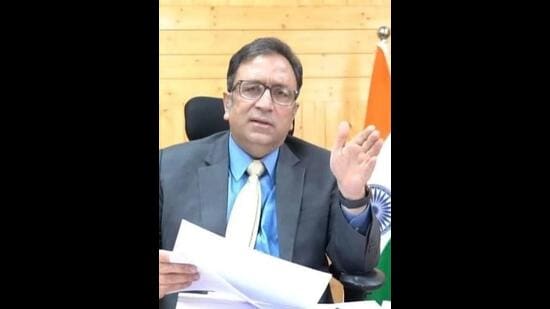
A day after Ladakh bodies rejected the draft proposed by the Union ministry of home affairs (MHA), Ladakh chief secretary Ashish Kundra on Saturday termed it “unfortunate” that the Ladakh leadership rejected the draft proposal within two hours.
The Leh Apex Body (LAB) and Kargil Democratic Alliance (KDA) have held several rounds of talks with the MHA. The Ladakh leadership has been demanding statehood and Sixth Schedule, but talks have remained inconclusive.
“During negotiations on the Sixth Schedule, it was explained that this provision applies to states, particularly in the northeastern region, where a minority tribe needs protection against any discriminatory action by a majority tribe. Therefore, the Sixth Schedule has a different geographical, historical and cultural context, and its relevance in the case of Ladakh is not particularly significant in the same way,” Kundra said at a press conference in Leh.
He said that when the meeting was held on October 15, the people of Ladakh wanted to see the documents and understand what kind of structure would be created, what its framework would look like, and how the process would move forward.
“After considerable deliberation, the MHA provided a 32-page document to the leaders of Ladakh on the morning of October 16. I want to make one thing very clear through you: the constitutional amendment and the kind of democratic structure the people of Ladakh want will emerge through discussion and deliberation. We do not want to submit a draft unilaterally. We want a framework that has the broad agreement of Ladakh’s leadership. We had expected this to happen in a positive manner. Naturally, nobody can read a 32-page document immediately and provide a response. We suggested that the leaders study it and that another meeting be convened after a week or 10 to 15 days,” he said.
{{/usCountry}}“After considerable deliberation, the MHA provided a 32-page document to the leaders of Ladakh on the morning of October 16. I want to make one thing very clear through you: the constitutional amendment and the kind of democratic structure the people of Ladakh want will emerge through discussion and deliberation. We do not want to submit a draft unilaterally. We want a framework that has the broad agreement of Ladakh’s leadership. We had expected this to happen in a positive manner. Naturally, nobody can read a 32-page document immediately and provide a response. We suggested that the leaders study it and that another meeting be convened after a week or 10 to 15 days,” he said.
{{/usCountry}}Kundra said the Ladakh leadership suggested holding the meeting the very next day. “We conveyed to them (Ladakh leaders) to take some time to discuss the document in detail among themselves and consult the people they represent. They should also find out what the people of Ladakh want. We had provided them with the draft. The expectation was that they would study it and tell us how to proceed. Unfortunately, that is not what happened,” Kundra said.
The chief secretary said that a separate three-page document was also provided to them. “It was not a draft document but a memorandum of understanding (MoU) setting out the matters on which the negotiating sides were agreeing. The MoU contained several provisions. For example, it stated that no Act of Parliament would apply unless the proposed body gave its consent on certain subjects.”
Kundra said that anything like Article 370 has already been abrogated, so there is no point in bringing that provision back in this manner.
“Unfortunately, I was deeply disturbed by what happened. I was surprised to see that within two hours of receiving the papers, they were ‘rubbished’. It was said that nothing had been offered and that there were no provisions for constitutional safeguards,” Kundra said.
He said that the discussion became stuck on just one issue: who will write the annual confidential report (ACR) of the chief secretary.
“We explained that the question of who would write the chief secretary’s ACR is dealt with under the Transaction of Business Rules. It does not form part of a constitutional amendment or the legislation establishing the body.”
He said that the government of India is fully committed to finding a political solution at the earliest and creating a democratically elected body that fulfills the aspirations of the people of Ladakh.
“Negotiations require two or three fundamental things. The first is mutual trust. Negotiations can take place only on the foundation of trust. If you do not trust the other side, it becomes difficult to understand what you are negotiating about. Discussion, debate and deliberation are part of our culture. Solutions emerge through these processes. We need openness of mind, mutual trust and, most importantly, patience. What we are trying to explain is that this is a complex exercise. It is not an easy task. A Bill to amend the Constitution is being prepared, and the framework of the legislation is being developed.”
Kundra said they should not rush into something that may become the framework for the next 50 years or even longer. “We cannot predict what will happen in 50 years, but whatever structure is created should satisfy the people, the political leadership and ordinary citizens. They should feel that a framework has emerged that meets their expectations.”
He said the draft gave very clear provisions for constitutional safeguards. “I have already mentioned Article 371 and the kind of constitutional safeguard which is envisaged in the draft. If the leaders have any ideas or suggestions, they should provide them.”
Kundra said sometimes things are said for “political rhetoric”. “I am hopeful that the leaders will realise that we are fully committed to this process, to its integrity and to achieving a positive outcome at the earliest,” Kundra added.