They allege that shanties and houses have occupied government land at several locations and raised questions over official oversight
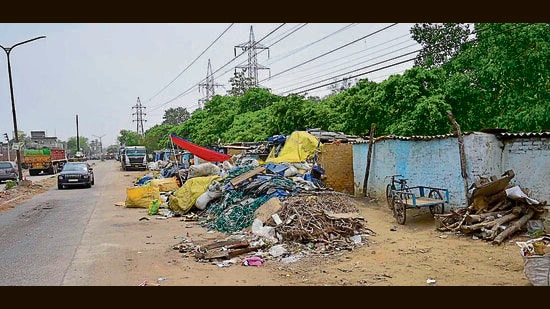
Ludhiana Industrial representatives have flagged decade-old encroachments on the green belt of the Focal Point Industrial Area, alleging shanties have come up on government land at several locations and some settlements have even got electricity wires. They have questioned how the occupation has been allowed to persist for years despite complaints and periodic anti-encroachment drives.
According to industry representatives, the issue has moved beyond temporary roadside encroachment. Several stretches have developed into established settlements where people have allegedly been living for years. Parked trucks, roadside activities and garbage have further eaten into the green belt and narrowed roads in the industrial area.
The presence of electricity infrastructure at some of the settlements has emerged as a particular concern. Industrialists have questioned whether the concerned authorities are aware of the occupation and how electricity wires reached structures on government land.
Rajeev Jain, senior vice-president of the Federation of Industrial & Commercial Organisation (FICO), said, “The green belt has been encroached upon at many places. Illegal houses, parked trucks and other occupations have reduced the available road space, making it difficult for people to move around. In several locations, the green belt has also been turned into a dumping area. Focal Point is one of Ludhiana’s biggest industrial hubs, but its present condition does not reflect that. A permanent solution is needed instead of short-term action,”
Rahul Ahuja, former chairman of the Confederation of Indian Industry (CII), Punjab, said the encroachments had substantially reduced the effective width of roads. “A 200-foot-wide road has practically become much narrower due to encroachments. Near Vishwanath Mandir, permanent illegal houses have existed for years, while trucks parked on roads have turned public spaces into private parking areas. Covering just 2.5 km can take nearly 25 minutes. The issue has been brought to the notice of the authorities, but a lasting solution is still awaited,” he said.
{{/usCountry}}Rahul Ahuja, former chairman of the Confederation of Indian Industry (CII), Punjab, said the encroachments had substantially reduced the effective width of roads. “A 200-foot-wide road has practically become much narrower due to encroachments. Near Vishwanath Mandir, permanent illegal houses have existed for years, while trucks parked on roads have turned public spaces into private parking areas. Covering just 2.5 km can take nearly 25 minutes. The issue has been brought to the notice of the authorities, but a lasting solution is still awaited,” he said.
{{/usCountry}}Industrial representatives said the persistence of the settlements raised questions about enforcement on government land and have sought an explanation for how structures allegedly occupying the green belt for more than a decade had been allowed to remain and expand, and why electricity infrastructure had reached some of the settlements. They have demanded that the authorities demarcate the green belt, remove permanent encroachments and examine the electricity infrastructure serving the settlements. It has also sought measures to ensure that cleared land is not occupied again.
Zonal commissioner, Zone B, Neeraj Jain said, “People who have been living at a place for a long period cannot be removed without an alternative arrangement under the government’s policy. They have to allot a flat or land to rehabilitate them. We are working on the issue.”