The two-day Kisan Mela at Punjab Agricultural University (PAU) opened on Friday with farmers from Punjab and adjoining states turning up in numbers to explore new crop varieties, farm technologies and opportunities to improve agricultural income.
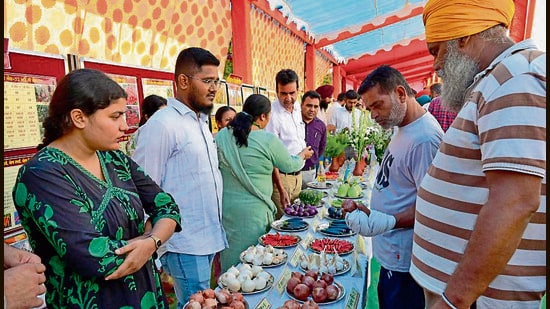
Organised by the directorate of extension education, the mela is being held under the theme “Adopt scientific farming for overflowing farm income”. Long queues were seen at stalls offering crop varieties, planting material, biofertilisers and farm literature. Advanced agricultural technologies, agronomic practices, processed food products, beverages, clothing and handmade household items drew visitors.
Chief minister Bhagwant Mann inaugurated the event. Agriculture and farmers’ welfare minister Gurmeet Singh Khuddian, the special guest, said Punjab farmers and PAU had played an important role in the green revolution and the country’s transformation from food deficit to food surplus. Punjab contributes 40% of paddy and 25% of wheat to the central foodgrain pool, he said.
“Farmer’s prosperity is a way to Punjab’s prosperity,” Khuddian said, assuring farmers of state support. Expressing concern over groundwater depletion, he said farmers were being given ₹1,500 per acre as an incentive for conserving water through direct-seeded rice. He also said farmers had received 14-15 hours of uninterrupted power supply daily during the past four years, barring technical disruptions this year.
Khuddian encouraged farmers to adopt animal husbandry and paddy straw management technologies for sustainable livelihoods and a pollution-free environment.
{{/usCountry}}Khuddian encouraged farmers to adopt animal husbandry and paddy straw management technologies for sustainable livelihoods and a pollution-free environment.
{{/usCountry}}PAU vice-chancellor and registrar Sukhjeet Pal Singh said the large turnout reflected the university’s strong rural and urban outreach and the bond between farmers and scientists. He said farmers were facing challenges including water depletion, soil degradation, weather fluctuations and declining incomes, but continued to contribute significantly to the nation’s food supply.
He urged farmers to adopt PAU-recommended crop varieties and technologies, use improved household technologies and follow the university’s WhatsApp groups and other information and communication tools. He also encouraged farmers to move towards agri-entrepreneurship and appealed to them not to burn paddy straw but use residue-management technologies.
AS Dhatt, director of research, highlighted water-, soil- and climate-smart varieties, including wheat PBW 887 and PBW 927, masar LL 1613, summer mungbean SML 2575 and mustard Punjab Raya Canola 7 and Punjab Raya 813. Fruit and vegetable varieties were also promoted.
MS Bhullar, director of extension education, urged farmers to take skill-based training from Krishi Vigyan Kendras and expand agri-business and subsidiary occupations.
Six progressive farmers were honoured for excellence. Jobandeep Singh of Amritsar and Gurmeet Singh of Hoshiarpur received Sardar Surjit Singh Dhillon awards for crop diversification. Kulwinder Singh of Patiala received the Sardar Dalip Singh Dhaliwal Memorial Award, while Manpreet Singh of Ferozepur received the Sardar Ujjagar Singh Dhaliwal Memorial Award for vegetable production. Gurdial Singh of Gurdaspur and Baldhir Singh Bhullar of Faridkot received Parwasi Bharti Awards for scientific farming. Babu Singh Brar Chappar Award was given to Mohikalan village of Patiala.
TS Riar, additional director communication, urged farmers to use PAU’s skill development centre, seek financial assistance through the Punjab Agri Business Incubator project and connect with experts through social media.
‘Humid weather raises rice blast, foot rot concerns’
Warm and humid weather has raised concerns over rice blast, foot rot and other crop diseases among farmers with scientists advising integrated disease management instead of relying solely on one method.
Sandeep Jain, department of plant pathology said rice blast was emerging as one of the major concerns. The disease thrives in moisture and is likely to spread when night temperatures fall, particularly towards the end of September and during the first week of October. Farmers have been advised to use recommended fungicides to control the disease.
Foot rot remains particularly prevalent in Basmati rice, especially after the widespread cultivation of the 1121 variety across Punjab. Jain said the fungus enters plants through infected seed, disturbing hormonal growth and causing excessive plant height without proper grain formation. He recommended seed treatment with the biological agent Trichoderma asperellum. He said PAU had registered the chemical with the central insecticides bureau, describing it as the first such registration by an Indian university.
Jain said potato scab and scurf were also prevalent in Punjab. Along with seed treatment, farmers should select healthy seed for sowing and adopt green manuring. He stressed that integrated disease management, combining several preventive measures, was more effective than depending only on chemicals.
Farmers also sought advice on root-knot nematodes, which live in soil and weaken plants. Jain said affected plants may show yellowing, poor growth and reduced yields. Management involves an integrated approach using four to five methods rather than a single treatment.
Scientists at the mela said changing weather conditions were increasing the need for timely disease identification and preventive measures. The Mela will conclude on Saturday.