In a remarkable achievement, Satya Bharti School in Lakhowal, has been honoured with the Changemaker Award at the Centre for Science and Environment’s (CSE) annual Green Schools Awards, emphasising its commitment to environmental sustainability.
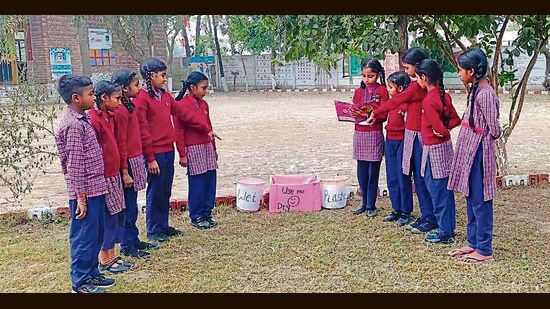
The award recognises the schools that have shown exemplary efforts in making their campuses eco-friendly and fostering environmental consciousness among students.
Out of the 5,300 schools from 29 states and union territories that participated in the Green Schools Programme, 199 schools from across India were certified ‘green’ at the awards ceremony on January 30.
The Changemaker Awards, recognising schools that elevate their sustainability rating to green through continuous monitoring and improvement, were presented to two institutions. Satya Bharti School, Lakhowal, Ludhiana, and PM SHRI Kendriya Vidyalaya No 1, Ordnance Factory, Katni, Madhya Pradesh, stood out as exemplary achievers in this category.
Satya Bharti School in Ludhiana stood out as a “changemaker”, the only one in Punjab, by successfully transitioning to the green category from yellow by implementing sustainable practices over the past year.
Ekta, the head teacher of Satya Bharti School, Lakhowal, expressed joy over the school’s achievement, stating, “In the last year, we made several initiatives to move to the green category from yellow. All staff members and students now commute to the school via public transport to reduce the carbon footprint. We organise regular sessions for students to learn about the sustainable practices for a greener future.”
{{/usCountry}}Ekta, the head teacher of Satya Bharti School, Lakhowal, expressed joy over the school’s achievement, stating, “In the last year, we made several initiatives to move to the green category from yellow. All staff members and students now commute to the school via public transport to reduce the carbon footprint. We organise regular sessions for students to learn about the sustainable practices for a greener future.”
{{/usCountry}}The Satya Bharti School Lakhowal has implemented several changes as part of the Green School Programme (GSP). These include the introduction of separate bins for dry and wet garbage to promote proper waste disposal. Students have taken on increased responsibility by turning off fans and lights when leaving classrooms, as well as promptly addressing running water taps to conserve water.
Teachers now prioritise public transport over personal vehicles, contributing to a reduction in energy usage. The school has made a conscious effort to minimise energy consumption by adopting LED bulbs. Additionally, extensive tree planting initiatives have been undertaken to enhance greenery on the school grounds.
Students are actively contributing to sustainability by using rainwater and wastewater for the school’s kitchen garden. To promote environmentally friendly commuting, public transport and bicycles are now being favoured over private transportation for student travel.
The school has revamped its Mid-Day Meal (MDM) menu, opting for fruit and healthy food options over packaged alternatives. These collective efforts aim to foster a more eco-friendly and sustainable environment within the school community.
The Green Schools Programme (GSP), a 19-year-old initiative by CSE, facilitates schools and students in conducting rigorous in-campus environmental audits to measure resource management efficacy and promote green practices. Schools take ownership of their green journey through self-conducted audits with CSE’s guidance.
Tushita Rawat, the programme manager for environment education at CSE, explained, “The programme uses an analytics platform to track the environmental performance of schools. Over 600 data points are collected, providing quantifiable environmental impacts within and around the school campus.”
The awards also recognised the state of Punjab as the “Best State” and Sangrur as the “Best District” for their leadership in fostering a culture of environmental consciousness. Punjab secured the award for the best state by registering the highest number of audit submissions, with 4,734 schools participating and 70 rated “green”.
What makes the school ‘green’?
A green school is characterised by its commitment to resource efficiency, meeting specific benchmarks. These include maintaining a window to floor ratio (WFR) exceeding 5% to ensure adequate daylight and ventilation. The majority of the population is encouraged to use sustainable modes of transport, such as public transport or non-polluting options like cycling and walking.
Such schools prioritise the maximum use of energy-efficient lighting to conserve energy, endorsing alternative energy sources. There is a strong emphasis on maintaining a substantial green cover inside and around the school campus, promoting biodiversity through the planting of native species. The school’s commitment to healthy living extends to serving only cooked meals, avoiding packaged foods high in fats, sugar, and salt.
Green schools implement rainwater harvesting (RWH) systems and reuse treated wastewater. Regular pre and post-monsoon cleaning of RWH systems is crucial for optimal functionality. Efficient segregation of waste at the source and responsible disposal are key aspects, with a strong recommendation to recycle at least 90% of the waste. Additionally, wet waste is composted, and the burning of waste is strictly prohibited.