To boost Ludhiana’s bicycle industry, which manufactures 90 per cent of the bicycles in the country, representatives of All-India Cycle Manufacturers’ Association (AICMA) and United Cycle Parts Manufacturers’ Association (UCPMA) on Saturday identified five turnaround areas, including empowering MSMEs and to build safe cycling infrastructure in 8,000 cities and towns.
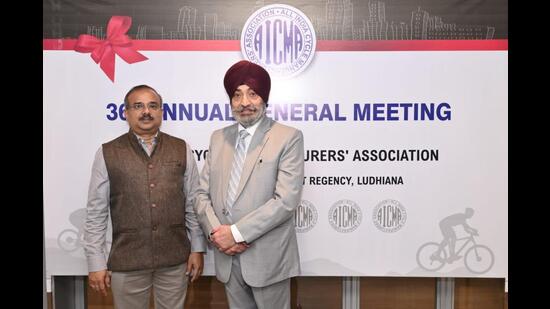
The decision was taken in a joint meeting of representatives of the associations. In the meeting, they decided to pursue a common goal of increasing the industry’s growth by four-times (i.e. USD 5.21 billion) by 2030.
The turnaround areas include empowering MSMEs; to migrate from voluntary to mandatory minimum standards of bicycles and their parts; to upgrade company-level technology through production-linked investment scheme support as a viability gap funding; to create world-class testing and certification and to build safe cycling infrastructure in 8,000 cities/towns.
These areas will boost the industry at global level by 2030, said UCPMA president DS Chawla. The two associations passed a resolution for creating a world-class bicycle manufacturing ecosystem in India. AICMA preaident U Rajagopal said there were social, environmental and economic benefits of bicycles.
As per a 2019 report of The Energy and Resource Institute (TERI), it is estimated that rather than using other transports, ₹1.8 trillion (i.e. 1.6 per cent of India’s GDP) can be saved annually by using bicycles for short-distance trips.
{{/usCountry}}As per a 2019 report of The Energy and Resource Institute (TERI), it is estimated that rather than using other transports, ₹1.8 trillion (i.e. 1.6 per cent of India’s GDP) can be saved annually by using bicycles for short-distance trips.
{{/usCountry}}The industry, since Independence, has a total of 4,000 micro, medium and large units with 10 lakh jobs. It is the second largest in terms of production with around 20 million bicycles per annum. However, with the global trends, the demand of bicycles has shifted from heavy (steel) to lighter bicycles and high-premium components such as multi-gear, disc brakes and suspension. Amid this transition, India is increasingly becoming import dependent and this is gradually reducing the country’s manufacturing dominance.