As several mustard growers are struggling even to recover cost input by selling their produce, the Punjab government has planned that from the next rabi season, oilseeds would be purchased by Markfed, a state-run premium cooperative organisation, on account of a market crash.
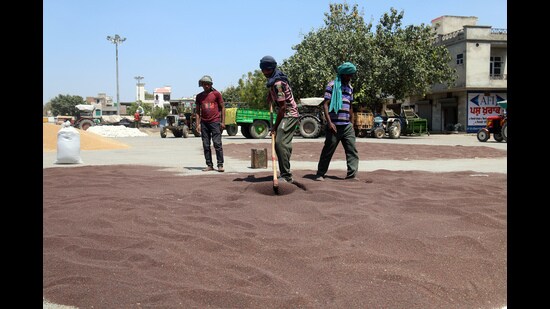
State agriculture director Gurvinder Singh said on Sunday that the move will help in boosting diversification in rabi crop cycle.
“Last year private players paid farmers much higher rates than the MSP. But our hopes were dashed after rates of mustard seed crashed unexpectedly. From next season, if the farmers are paid below the MSP, the state government would buy the stock from farmers,” he added.
Sources said Markfed is a market leader in the cooking oil sector and its presence in the market can play an important role stabilising oilseed rates.
Nachhatar Singh took 13-acre land on lease at Bathinda’s Naruana village hoping to earn well from the mustard crop for the second consecutive season this time.
But his hopes were dashed as the buyers are not even paying him ₹4,000 per quintal, less by more than 1,500 of the minimum support price (MSP) of ₹ 5,450.
“In 2021 for the first time, I ventured into mustard cultivation by taking 12 acres of lease and earned handsomely as the market rates last year were as high as ₹7,000 for a quintal. This time I added another acre as a plan for rabi crop diversification but I am unable to recover even the cost input of ₹12,000 per acre that included lease amount, seeds and fertilisers. I am keeping my entire yield for another 2-3 weeks hoping the rates may improve. The government should have a defined plan to assist farmers in such circumstances while pushing crop diversification,” he said.
{{/usCountry}}“In 2021 for the first time, I ventured into mustard cultivation by taking 12 acres of lease and earned handsomely as the market rates last year were as high as ₹7,000 for a quintal. This time I added another acre as a plan for rabi crop diversification but I am unable to recover even the cost input of ₹12,000 per acre that included lease amount, seeds and fertilisers. I am keeping my entire yield for another 2-3 weeks hoping the rates may improve. The government should have a defined plan to assist farmers in such circumstances while pushing crop diversification,” he said.
{{/usCountry}}State agriculture authorities said in 2022-23, Punjab witnessed mustard cultivation on about 60,000 hectares or 1.50 lakh acres in the semi-arid districts of Fazilka, Bathinda, Muktsar, Mansa and a few other parts of the state.
As per the official data, last time in 2004-05 rabi crop cycle, Punjab touched 60,000 hectares.
However, it was much less than 1974-75 when the total area under the crop in the state was 4.4 lakh acres.
Market watchers say as the government failed to intervene when farmers were paid less rates this year, rabi diversification push is likely to get discouraged in Punjab.
A leading mustard trader Rakesh Rathi said edible palm oil imported is available cheaper and it has a direct fallout on the domestic oilseed market.
“This year the mustard seed is being purchased at less than the MSP. The trend may have an adverse impact on the morale of farmers who may be forced to step away from wheat. The centre government should increase duty on imported oil as a measure to support mustard growers,” said Rathi.
A progressive farmer from Abohar in Fazilka, Nikhil Setia said after a low wheat yield in 2022 and a poor yield of cotton in the last two seasons, he sowed oilseed on 18 acres for the first time.
“But it was a discouraging experience. Rates of mustard seeds are dismal even as farmers got an average yield of 7-8 quintals per acre. Since mustard is a low labour-intensive crop, demands lesser cost input and requires very little irrigation with the scope of handsome returns, it is a good alternative to wheat. But it needs an initiative from the government to balance the market if farmers are paid less for their produce,” said Setia.