With paddy harvesting in Punjab expected to begin by the last week of September, the state agriculture department has prepared an action plan to strengthen crop residue management and further curb stubble burning.
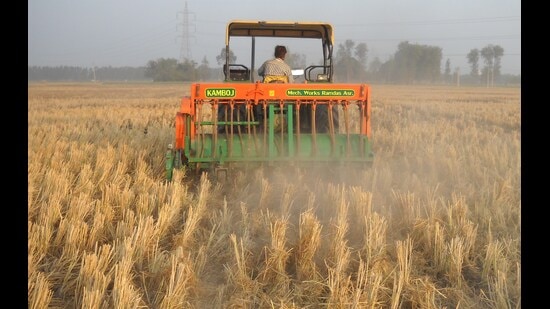
Under the plan, 22,500 crop residue management machines will be offered to farmers and other eligible beneficiaries at subsidised rates for in-situ and ex-situ management of paddy straw. In-situ management involves chopping, mulching and mixing residue into the soil, while ex-situ management involves removing straw from fields for use elsewhere, including as industrial fuel.
The Centre has sanctioned ₹576 crore for crop residue management in Punjab this year, with the state focusing on machinery for managing residue within fields as well as infrastructure for collecting and utilising straw outside farms.
Paddy straw burning in Punjab, Haryana and western Uttar Pradesh is among the factors contributing to the seasonal deterioration in air quality in the National Capital Region during October and November. Farmers often have a short window between paddy harvesting and wheat sowing, making burning a quick way to clear fields.
Super SMS, super seeder machines in focus
{{/usCountry}}Super SMS, super seeder machines in focus
{{/usCountry}}The biggest focus this year is on Super straw management system (Super SMS) machines, which are attached to combine harvesters to chop and spread paddy straw evenly across fields. This enables farmers to manage residue in situ without burning it. As many as 7,500 Super SMS machines have been included in the proposed distribution. Another 6,600 super seeder machines have been proposed under the subsidy programme. These tractor-operated machines mulch and incorporate paddy residue into the soil while simultaneously sowing seeds and applying fertiliser.
Other machines included in the plan are reverse ploughs, zero-till drills, Happy Seeders, surface seeders and mulchers.
For ex-situ management, the state has proposed 2,200 rake machines and 2,200 balers to collect, bundle and transport paddy straw for use by industries and other facilities.
Record paddy area raises residue concerns
Paddy has been cultivated over an all-time high area of 32.76 lakh hectares in Punjab this year, raising concerns over the quantity of residue generated after harvesting.
An agriculture department official said the state’s average paddy yield is around 210 lakh tonnes, along with nearly 200 lakh tonnes of straw. According to state data, around 120 lakh tonnes of residue is incorporated into the soil, while the remainder is available for use as fuel or is potentially burnt. Officials said timely availability of functional machinery will be crucial because farmers have limited time to prepare fields for the next crop.
₹2,000-cr support since 2018
The current assistance marks the ninth consecutive year since 2018 of central support for crop residue management in Punjab. From 2018 to 2025, around ₹2,000 crore was disbursed for subsidised machinery.
Around 1.6 lakh machines have been supplied so far, but officials estimate that nearly 40,000 have become redundant due to wear and tear. Most machines have a lifespan of five to six years.
Individual farmers are eligible for a 50% subsidy, while custom hiring centres, farmer groups, village panchayats and cooperative societies can receive an 80% subsidy.
According to the action plan, ₹497 crore has been earmarked for subsidised machinery and related interventions. Of this, ₹145 crore is for machinery for custom hiring centres, while ₹65 crore has been allocated for awareness activities and support for pellet manufacturing units that convert paddy straw into boiler fuel.
Farm fires decline by 94%
An agriculture department official said concerns over air pollution from stubble burning led to central intervention and dedicated financial assistance. The assistance was initially provided as a 100% grant but was later converted into a contributory model, with the Centre contributing 60% of the allocation.
Official data shows farm fires in Punjab fell from around 83,000 in 2022 to 5,114 in 2025, a decline of about 94% over four years. The Commission for Air Quality Management (CAQM) has set a target of bringing farm fires down to zero.
Mahanbir Singh, principal scientific officer with the council, said the expansion could take total straw utilisation to around 60 lakh tonnes.
The growing demand for straw is also providing farmers with an opportunity to earn from crop residue instead of burning it.
According to Singh, farmers can earn around ₹1,500 to ₹1,800 per tonne by selling paddy straw during the harvesting season. The price can rise to around ₹3,000 to ₹4,000 per tonne during the rest of the year.
Punjab is also promoting the use of paddy straw in industrial boilers and brick kilns. Around 2,000 brick kilns in the state have been asked by CAQM to use paddy straw as fuel, while boilers are also being manufactured to operate on biomass-based fuel.