Talking about art in prisons, what comes to mind at once is a peppy song by none other than the King of Rock and Roll: Elvis Presley. It was titled “Jailhouse Rock” for a 1957 musical drama film originally named ‘The Hard Way’. The song, penned by Jerry Leiber and Mike Stoller, was sung with such abandon by Presley that the film was released with the name of the song as its title, and the rest is history.
Interestingly, the song was part of a party thrown by the warden inside a county jail. Elvis played a construction labourer who is sent to prison for accidentally killing a man in a bar fight where spirits were running high. He learns to play the guitar behind bars, and lo! He becomes a famous rock & roll star once out of jail. The song went on to become a great hit at home and abroad.
Back to Indian soil
Having begun with one of the peppiest behind-the-bars songs of the west, one returns home to good old India, with its deep roots of culture and civilisation, to come across some of the most surprising prison tales dating back many centuries. But before tracing the roots of jail arts on home ground, a question comes to mind: Why do prisons become hubs of art and literature despite their closed and unhappy conditions?
The answer to this query lies in the famous phrase, “survival of the fittest.” Locked behind bars, the convict’s need for self-expression reaches an all-time high. It is then that words and visions embrace the soul. All external diversions and obligations are gone, and a dialogue begins with one’s own soul. The arts provide the space to explore what was, what is, and what could be. It is indeed the need to “look before and after” and come out a winner from darkness to light.
{{/usCountry}}The answer to this query lies in the famous phrase, “survival of the fittest.” Locked behind bars, the convict’s need for self-expression reaches an all-time high. It is then that words and visions embrace the soul. All external diversions and obligations are gone, and a dialogue begins with one’s own soul. The arts provide the space to explore what was, what is, and what could be. It is indeed the need to “look before and after” and come out a winner from darkness to light.
{{/usCountry}}Since the Indian civilisation is ancient, the prison writing dates back to the Sangam age in ancient Tamil Nadu (around 300 BC to 300 AD). A notable example is a poem written by King Cheraman Kanaikkal, a Chera dynasty monarch who composed verses when he was imprisoned after losing a war to the Chola king, Sengannan. The verses address honor and pride even in captivity.
Moving on to the medieval period, Bhadrachala Ramadasu, a 17th-century Telugu saint-poet, devotee of the Hindu god Rama, and composer of Carnatic music, spent 14 years in solitary confinement in the Golconda prison during the Qutb Shahi reign. Yet, he continued to compose verses in praise of Rama.
The Independence struggle
During the long struggle for independence from British colonial rule, one of the most cherished writings is ‘My Jail Diary’ by revolutionary Bhagat Singh, who went to the gallows and lives on in the hearts of the Indian people as a much-cherished folk hero, ever brave and always young. His atypical jail notebook was written over his last three years imprisoned in the Lahore Central Jail from 1929 to 1931. The 23-year-old revolutionary wrote it by hand in an attempt to gain strength to face the ultimate sacrifice as he was awaiting trial and sentencing in the Lahore Conspiracy case. The diary includes notes and quotes from many philosophers and writers like Karl Marx, Rabindranath Tagore and Vladimir Lenin, reflecting his firm faith in socialism, freedom and equity. His last spoken words were “Inquilab Zindabad!”
Stone walls do not make a prison
So said Mahatma Gandhi, who spent some seven years in jails in South Africa and during the struggle for his country’s independence. His series of hundreds of letters written behind bars advised freedom fighters on restraint, discipline and self-respect. Gandhi drafted large portions of his autobiography while imprisoned at Yerawada Central Jail in Pune, Maharashtra. It was later published in weekly instalments in his journal, Navajivan.
Jawaharlal Nehru was to write his autobiography, ‘Toward Freedom’, entirely in prison. Letters from a Father to His Daughter was written by Nehru from different prisons to his 10-year-old daughter, Indira Gandhi. This collection of 196 letters on world history was written between 1930 and 1933. These were written to bridge the gap that had come between them due to his imprisonment and to educate her with a broad vision of the world she was growing up in. Writing connected them so that she would not feel the absence of her father. The Discovery of India was yet another book written by Nehru between 1942 and 1945 when he was imprisoned in Ahmednagar fort in Maharashtra, and it remains a bestseller to this day.
Staging court martial in Tihar jail
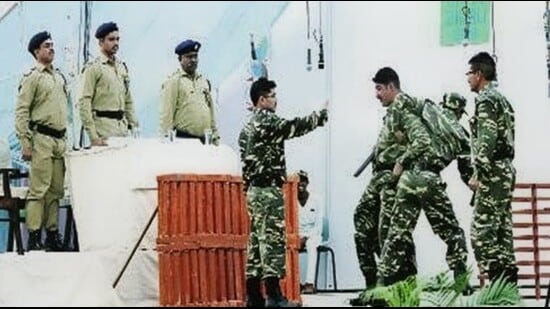
Our cherished fiction writer and playwright, Swadesh Deepak, who went away from us all too soon without giving any notice, would have been thrilled to know that his famous play, Court Martial, which tells the story of recruit Ram Chander belonging to a lower caste, who is tried for murdering one of his officers for insulting his origins, was to be staged, of all places, in Tihar jail of Delhi.
The production came to life when Dastangoi storyteller Mahmood Farooqui, an inmate from une 2015 to September 2017 before his acquittal, formed a theatre group with fellow prisoners. Farooqui recalled training the actors to march like soldiers until each tried to outshine the other. The director recalled: “I could not have asked for a better reception.” Indeed, the director general of prisons praised the production as chief guest, suggesting it be staged across all jails.
nirudutt@gmail.com