With demand for silk products rising, the Punjab forest department has expanded its sericulture initiative to Hoshiarpur after Pathankot, launching a project in the Dasuya forest division aimed at improving the livelihoods of landless, marginal and small farmers by putting vacant forest land in the Kandi belt to productive use.
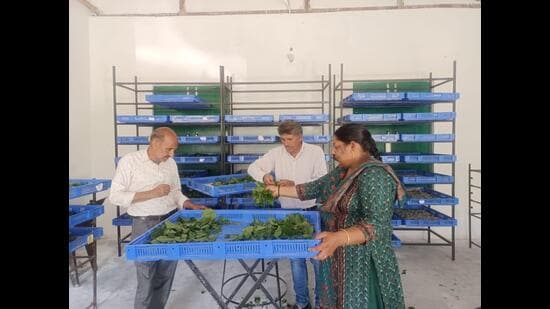
The project is being implemented under the Union ministry of textiles, with the Bengaluru-headquartered Central Silk Board (CSB), and has already received approval.
Sericulture refers to rearing silkworms for silk production, involving mulberry cultivation, silkworm rearing, and harvesting silk cocoons.
The project, titled “Livelihood Improvement of Sericulture Farmers in Dasuya Forest Division of Hoshiarpur district of Punjab by Utilisation of Vacant Forest Land in Kandi Areas under Silk Samagra-2 Scheme,” seeks to integrate mulberry cultivation and silkworm rearing with existing forest activities without disturbing the forest ecosystem. The project document identifies the Kandi belt as having considerable potential for bivoltine silk production.
The project has been estimated to cost ₹1.42 crore, with the Centre contributing ₹1.21 crore and the state forest department ₹20.90 lakh. No financial contribution is proposed from the beneficiaries.
In 2023, the forest department had undertaken a sericulture initiative in the underdeveloped Dhar revenue block of Pathankot as a pilot project to assess the viability of the activity in the Kandi region. Building on that experience, the department has now proposed extending the model to Hoshiarpur. In the last three years, about 8 tonnes of silk cocoon have been produced in Pathankot.
{{/usCountry}}In 2023, the forest department had undertaken a sericulture initiative in the underdeveloped Dhar revenue block of Pathankot as a pilot project to assess the viability of the activity in the Kandi region. Building on that experience, the department has now proposed extending the model to Hoshiarpur. In the last three years, about 8 tonnes of silk cocoon have been produced in Pathankot.
{{/usCountry}}Sanjeev Tiwari, chief conservator of forests (hills), said the department had decided to expand the initiative in view of the growing demand for silk products. The Dasuya project will cover 51 beneficiaries from Niku Chak and Jugial villages in the Mukerian and Talwara-I forest ranges. Of them, 31 are men, and 20 are women.
The project will utilise 34 acres of forest land for 10,300 mulberry trees—10,000 at Niku Chak and 300 at Jugial. The forest department has already raised the plantation during 2022-23 and 2023-24, with the trees expected to support silkworm rearing involving around 4,000-5,000 disease-free layings (DFLs) per season.
Dasuya divisional forest officer (DFO) Jarnail Singh Bath said the required infrastructure was being put in place and the existing mulberry plantation would provide foliage for the proposed activity.
A key component is a one-acre Kissan Nursery at Niku Chak (Asafpur) forest nursery, aimed at producing mulberry saplings and strengthening the availability of planting material. The nursery has an estimated cost of ₹1.50 lakh, with 100% assistance proposed from the Centre.
The project also proposes 17 community rearing houses, each measuring at least 1,000 square feet and capable of accommodating 250 DFLs per batch. Three farmers will be attached to each centre. The component will cost an estimated ₹76.50 lakh. A Chawki rearing centre with a capacity of 5,000 DFLs per batch is also proposed at Niku Chak.
Besides rearing equipment and disinfectants, the project provides for training and exposure visits. The forest department will serve as the nodal agency, coordinating with the horticulture department, village forest committees and self-help groups, while the Central Silk Board will provide technical support. Marketing assistance will also be facilitated through temporary markets and outside buyers to help farmers secure better prices for their cocoons.