Strap: Rejected bank loan sparked a ₹4-crore beekeeping revolution for 300 rural women in the district
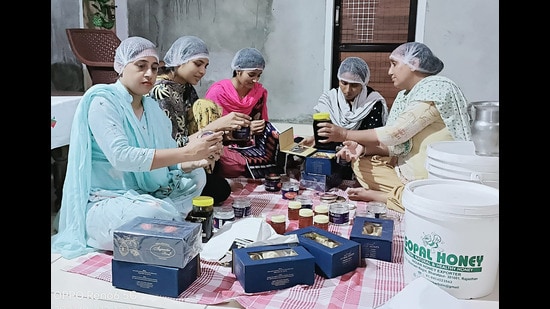
A beekeeping initiative is enabling nearly 300 rural women in Bathinda district to strengthen their families’ livelihoods after five years of harvesting honey.
Started after their loan application was rejected by a nationalised bank in 2021, the women self-help groups (SHGs) in five villages have grown into a women’s empowerment movement, and they now hope to produce 75,000 kilograms of honey worth nearly ₹4 crore this year.
In 2021, Bathinda was selected under the Centre’s One District One Product (ODOP) programme to provide an alternative livelihood model for farmers in the district.
Mentored by experts at Krishi Vigyan Kendra (KVK), including Vinay Pathania, the participation of rural women in beekeeping in Bathinda has become noticeable.
During a recent visit to Bathinda, Union agriculture minister Shivraj Singh Chouhan met the progressive farmers and lauded the role of women apiarists for successfully breaking the patriarchal mindset associated with the honey production sector.
Jasveer Kaur is a leader of the enterprising group of five women from Dialpura Bhaike village that stepped into honey production, which was then considered a male-oriented avocation.
{{/usCountry}}Jasveer Kaur is a leader of the enterprising group of five women from Dialpura Bhaike village that stepped into honey production, which was then considered a male-oriented avocation.
{{/usCountry}}“Five years ago, when the state industry department informed us about the Pradhan Mantri Formalisation of Micro Food Processing Enterprises (PMFME) schemes, we contacted the bank but our loan application was rejected on the ground that beekeeping is too risky for women, as it requires migrating bee colonies to different places. Later, state officials assisted us in getting grants to step into honey production. Today, the SHGs have set an example that women are capable of excelling in the honey production business,” she said.
Besides raw and processed honey, enterprising women are also experimenting by selling honey-dipped dry fruits, garlic honey, ‘awla murabba’ and candy prepared with honey instead of sugar syrup.
Another active beekeeper, Amandeep Kaur, from Gaunspura village, said that different women SHGs in the district have nearly 3,000 bee boxes and each box produces nearly 25-30 kg of honey.
She said honey collected from different flora in Punjab, Rajasthan, Himachal Pradesh and Jammu and Kashmir is sold between ₹500-800 per kg.
Amandeep Kaur said that for almost the last month, bee boxes were taken to different parts of Rajasthan to enable bees to collect nectar from wild ber or jujube.
“Several women visit the sites where bee colonies are collected and their families actively assist them. From setting up the bee colonies, women manage the entire cycle of extracting, processing and selling honey. We are contributing to improve families in the sector, which has a bright future to make it an economically sustainable venture,” she added.
Manjot Kaur, 27, from Muhallan village joined her father’s unorganised business of honey in 2021 and is working to make it a profitable market product.
“My father, Makhan Singh Sandhu, used to sell raw honey between ₹100 and 150 per kg. He was banking on the limited mobility of bee colonies in Punjab and was sceptical if any of his three daughters could join the work. I decided to enter the honey production sector in 2021 and the annual turnover has seen a jump of 20%. It will improve further as now we are processing honey after collecting floral nectar from different states and selling it for more than ₹500 per kg,” she added.
A budding beekeeper from Jalal village, Sarabjit Kaur said that she is gearing up for forthcoming festive seasons in winters, Diwali and Gurpurb with apiary-based gift packings.
“I have learnt to make candles from beeswax and gift packs with small bottles of honey of different types. We visit kisan melas, exhibitions and other cultural fairs held in various districts,” she said.