An MBA student’s rape-murder in 2010 that sent shockwaves through the city. A probe that went cold for over a decade. A semen trail that finally brought the case back to life.
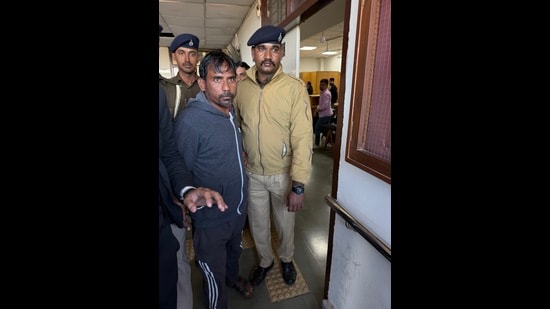
More than 15 years later, one of Chandigarh’s most haunting crimes reached its long-awaited conclusion as a local court awarded life sentence to the man who snatched a promising life.
The convict, Monu Kumar, now 39, was a 24-year-old taxi driver when he had targeted the 21-year-old woman on July 30, 2010.
ALSO READ | Raisen: Man accused of raping minor injured in police encounter, arrested
He had found her alone, talking on the phone while sitting on her scooter near a secluded taxi stand in Sector 38 West. Attacking her from the back with a heavy stone, leaving her half dead, he dragged her into the bushes, where he raped her.
The student was found in semi-naked condition and rushed to the PGIMER, Chandigarh, where she was declared brought dead. There were strangulation marks on the neck, and the body also bore injuries on the wrist, thigh and the back.
{{/usCountry}}The student was found in semi-naked condition and rushed to the PGIMER, Chandigarh, where she was declared brought dead. There were strangulation marks on the neck, and the body also bore injuries on the wrist, thigh and the back.
{{/usCountry}}“The convict does not deserve any sympathy,” observed the court of additional district and sessions judge Dr Yashika while pronouncing the sentence.
Convicted under Sections 302 (murder) and 376 (rape) of the Indian Penal Code, Kumar was also fined ₹50,000 each for both offences.
ALSO READ | Jalandhar rape and murder: ASI dismissed for ‘negligence in duty’; 2 PCR officials suspended
“This court is of the view that a requisite sentence has to be imposed upon the convict to protect the society as a legitimate response to the collective conscience. In other words it is an obligation on the court to the society, which has reposed faith in the court of law to curtail evil,” the judgment noted.
The court held that while the case did not fall under the “rarest of rare” category warranting capital punishment, it was “a case of its own kind”, where a man was arrested 14 years after the incident, with the help of meticulous forensic work by police and scientists.
According to police, Kumar was heavily intoxicated when he committed the crime. The chargesheet said Kumar took the victim’s two phones, sold one in the Industrial Area and discarded the other in a jungle. He also signed a receipt using a false address.
After his arrest in May 2024, the chargesheet was filed on August 2, 2024, and the charges were framed on August 21, 2024. The trial concluded in just over a year.
ALSO READ | Court to pronounce verdict in Kerala actress sexual assault case on December 8
Police said Kumar, who has studied till Class 7, hadn’t even registered for an Aadhaar card to evade arrest. He worked as an inter-city taxi driver and mostly stayed out of town.
A resident of now-razed Shahpur Colony in Sector 38 West, he originally hails from Uttar Pradesh.
Convict claims false implication
A father of two daughters, Kumar had separated from his wife in 2011. No one from his family showed up during the sentencing.
Speaking to media outside the court, Kumar maintained that he was innocent and set up by the police. His counsel, Sunil Kumar Pandey, said they will appeal against the verdict before the high court.
The defence counsel had argued that there was no direct evidence to nail his client. There were no eyewitnesses, and DNA testing was incomplete on four of the 26 markers.
He also argued that the IMEI number of the mobile phone, which Kumar was accused of stealing from the victim, was different from the one he had sold to a shop.
However, the court ruled, “A judge does not preside over a criminal trial merely to see that no innocent man is punished. A judge also presides to see that a guilty man does not escape.”
The court also appreciated the efforts of the police party, including investigating officer DSP Harditt Singh and SI Mohan Kashyap; and Dr Sunita, assistant director/scientist, stating that they contributed to the society at large by collecting evidence against a person who remained absconding for almost 14 years.
When the quantum of sentence was pronounced, the convict prayed for leniency, claiming he was the only support for his aged mother and had health issues. The prosecution, on the other hand, demanded the death penalty, arguing that there were cases of similar nature pending against him.
Semen trail revived cold case after 14 years
Having evaded arrest for over a decade, Kumar was nailed through semen preserved from the victim’s body. He was apprehended in May 2024 after an eerily similar crime in Maloya reopened the probe that had gone cold for 14 years.
Forensic analysis concluded that the semen samples from the bodies of both victims — the MBA student and a 40-year-old woman who met the same fate 2km away in Maloya locality in January 2022 — belonged to the same man. The second victim was found naked, with her mouth gagged with socks.
Months later, Kumar’s DNA also matched the semen found on the clothes of a 55-year-old woman, who was brutally murdered in Sector 54 on February 27, 2024.
Trial underway in two other murders
The trial against Kumar for the rape-murder of a woman in Maloya is going on in the same court. The proceedings in the Sector-54 murder are underway in another sessions court. Hearings of both cases are listed next for December 3.
Police officials maintained that while under this life sentence, Kumar will get out within 14 to 15 years, they will press for capital punishment in the Maloya rape-murder case as well.
As the FIR was filed in 2010, the sentencing is in line with the format prior to the Supreme Court’s 2014 judgment, which specified that life sentence means imprisonment till the end of the convict’s natural life.
For parents, life sentence too lenient for a ‘remorseless’ killer
For the parents of the victim, the punishment awarded to the convict does not reflect the severity and cruelty of the crime.
They believe he deserved nothing less than the death penalty, insisting that a man with a “completely remorseless and dangerous mind” can never be allowed back into society.
As the court pronounced life term for the man who raped and murdered their daughter in 2010, both parents broke down, recalling the cruelty their child suffered.
They had lived through 14 years of silence and fading hope, when the case lay untraced and no leads surfaced. Yet they clung to the belief that one day the truth would emerge.
After years of investigative silence, the breakthrough came when a forensic doctor noticed similarities in DNA between two separate cases and pushed to reopen the file.
“It felt like a miracle, and at the same time, a shock. We could not understand how two cases could be so alike and how the connection had gone unnoticed for years. But that determination to revisit the evidence gave us the first real path to the truth,” said the victim’s father, now 69.
‘She was strong, but didn’t get the chance to fight’
The father described his daughter as exceptionally strong. “My daughter was brave and powerful. She was a kabaddi player. If she had any chance, she would have fought. But he attacked her from behind. She didn’t even see it coming. He assaulted her when she was unconscious. She never had a moment to defend herself,” he said.
“She was intelligent, strong, full of dreams and determination. She had a future that most students only aspire to. But everything ended in a moment of cruelty,” said the distraught father.
‘He showed no remorse’
The family says the convicted killer displayed absolute emotional emptiness throughout the trial. “His face showed nothing. Not a single sign of guilt or regret. When the judge asked if he wanted to say anything, he remained silent. He had nothing to say, no apology, no explanation. It was chilling to see how blank and cold he looked.”
Walking out of the court, they said they respect the court’s judgment and accept the decision.
A cop’s chance encounter that unmasked the killer
A chance encounter and a cop’s instinct during a routine patrol were what led to a breakthrough in the 2010 rape-murder case that police had closed as “untraced” in 2020.
In 2023, the convict, Monu Kumar, was spotted by now retired inspector Jaspal Singh near the Sector 39 Water Works.
Having received common forensic leads in two similar rape-murder cases, involving the MBA student in 2010 and a 40-year-old woman in Maloya in 2022, police had started profiling suspects living in the vicinity of the murder scenes, collecting DNA samples of ragpickers, labourers, vegetable vendors and vagabonds.
Out for a patrol around then, inspector Jaspal noticed a man standing in a drunk and suspicious state. “Something about his behaviour was off. I felt he should not be ignored,” Jaspal said.
He was detained under preventive custody and his blood sample was collected inside the lock-up. Police released the man the next day, but kept a discreet watch on him at his residence in Shahpur Colony, Sector 38.
The DNA report arrived after seven to eight months, tying Monu Kumar to both the 2010 and 2022 cases. Semen samples preserved from the bodies of both victims matched with the DNA from his blood sample. After police failed to track him down in the first murder, he brazenly targeted the second victim 12 years later.
Armed with scientific proof, police apprehended Kumar, paving the way for trial to commence.
Initially, he denied involvement. When confronted with the DNA results, he confessed first to the 2022 murder and then to the 2010 crime, recalling minute details of the scene. “He remembered each and every detail — the spot, the sequence, the weapon, everything. Even after so many years, he hadn’t forgotten a single thing,” said inspector Jaspal, recalling the interrogation. The final day of remand, he admitted to the third murder — in Sector 54 in February 2024.
Interestingly, Kumar was questioned by Amanjot, then SHO of Maloya station, in 2010 itself. But he was released in the absence of witness testimony or DNA evidence.
Patterns were too similar to ignore: CFSL expert
The key leap in the probe came from CFSL scientist Sunita, who was handling forensic examination in the 2022 Maloya rape-murder case. Having visited both crime scenes — in 2010 and 2022 — she immediately sensed similarities.
“The patterns were too close. When I saw the bite marks and the assault pattern in the 2022 case, something struck me. Both these were untraced. I picked the 2010 file again and studied every detail. It was instinct. I decided to match the DNA, and the result confirmed it — it was the same man,” the forensic expert said.