Unseasonal rainfall, coupled with hailstorms and thunderstorms in October, has delayed wheat sowing in Haryana by leaving fields too wet to begin planting for the rabi season.
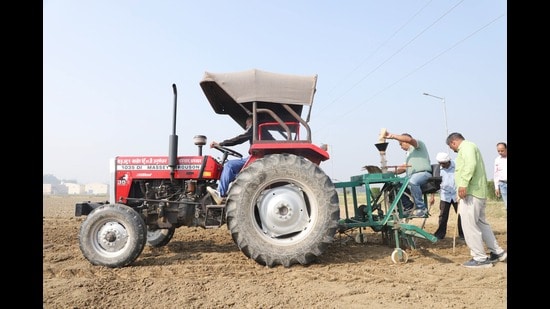
Scientists at the Indian Institute of Wheat and Barley Research (IIWBR) said that sowing usually begins by the second fortnight of October in the region and reaches 10% by the first week of November. “Rainfall activities have drastically delayed harvesting of previous crops and thus delayed sowing of rabi crops including wheat. As the situation improves, it is likely to pick up after Diwali,” principal scientist Anuj Kumar told HT.
According to the India Meteorological Department (IMD), Haryana witnessed 34.6mm of rain, which is 268% more than the normal precipitation of 9.4mm for the month of October. During this period, major wheat-producing areas, including Sonepat, received 85.3mm of rain—605% more than the normal 12.1 mm.
Similarly, other wheat-growing areas like Panipat received 79mm, Karnal (64mm), Kaithal (49mm), Kurukshetra (58mm) and Palwal (48 mm) rain in large excess (60% or more).
Scientists at the IIWBR said that they have started seed distribution, field inspection and disease identification as wheat sowing is set to pick up pace in the region.
According to Jaswinder Saini, the Karnal deputy director of agriculture (DDA), fields are still wet–particularly in the Nilokheri and Indri belts touching Kurukshetra–while paddy harvesting is still underway in parts of Assandh. “At this stage, wheat sowing is only under 2% in the whole district,” he added.
In the neighbouring Kurukshetra district, farmers have started sowing potatoes and other vegetable crops, though their planting was also delayed due to the rain.
{{/usCountry}}In the neighbouring Kurukshetra district, farmers have started sowing potatoes and other vegetable crops, though their planting was also delayed due to the rain.
{{/usCountry}}Undertake wheat, barley planting during the first two weeks of November: Advisory
According to the first advisory issued by the IIWBR for sowing and other practices across the country for the 2026-27 season, farmers have been advised to undertake wheat and barley planting during the first two weeks of November.
The wheat experts have advised to select suitable varieties based on sowing time, agro-climatic conditions and irrigation availability, and certified seeds from reliable sources to ensure uniform crop establishment and higher yields. In Haryana, the farmers prefer early sowing varieties of DBW 187, DBW 303, DBW 327, DBW 370-372 and WH 1270.
The Union ministry of agriculture has set the wheat production target at 121 lakh metric tonnes (LMT) for the 2026-27 season, slightly above the actual production of 120.7 LMT achieved in 2025-26. Experts believe that achieving the production target will be a challenge this year, given the slow monsoon and the effects of El Nino.