Having failed to promote electric vehicle public charging stations for over five years, allowing them to fall into disuse, the UT administration is now planning to revive them, while also greatly lowering the charging time.
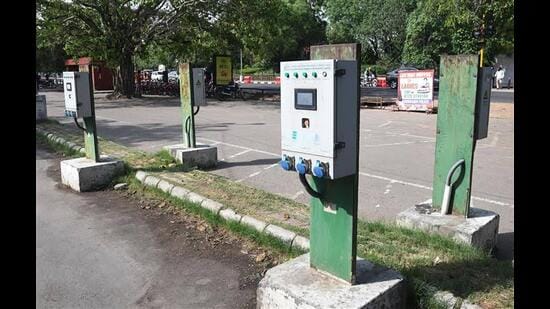
As per officials, currently the charging points take up to eight hours to charge a four-wheeler. Following the upgrade, that is expected to take six months, an electric car will be fully charged in around 1 hour.
Similarly, electric two-wheelers that are currently charged in three hours at these stations will be ready for use in 18 minutes after the revamp.
This holds significance as the UT transport department is likely to stop registration of non-electric two-wheelers from July, as the targeted number of such vehicles in the current financial year, as fixed under the 2022 Electric Vehicle (EV) policy, is expected to be met by June.
In 2023-24, nearly 6,200 petrol two-wheelers can be registered in the city as envisaged under the EV policy. Since the beginning of the financial year, around 3,700 fuel-run two-wheelers have already been registered in Chandigarh. As such, only around 2,500 more can be registered, which is likely to be achieved by the end of June.
Thereafter, the Registering and Licensing Authority (RLA) will be accepting registrations of only electric two-wheelers for the remainder of the current financial year.
{{/usCountry}}Thereafter, the Registering and Licensing Authority (RLA) will be accepting registrations of only electric two-wheelers for the remainder of the current financial year.
{{/usCountry}}UT had rolled out its EV policy in September 2022 that be applicable for five years, during which it plans to gradually stop registering fuel-run vehicles to dissuade people from buying vehicles that cause pollution.
Charging stations were set up in 2018
The public EV charging stations were set up under Centre’s Faster Adoption and Manufacturing of Hybrid and Electric Vehicles (FAME) scheme.
A total of ₹48 lakh were spent on installing eight charging stations, comprising 48 charging points, in the city under Phase 1 in 2018.
Now, the administration is planning to spend ₹40 lakh per station to upgrade them, translating into ₹3.2 crore for all eight.
“The charging stations were installed around five years back, but due to lack of awareness they were not being used at most locations. Also, the charging is very slow. The agency, which installed them will upgrade them with latest technology, accelerating the charging speed,” said Sukhwinder Singh Abrol, project director, Chandigarh Renewable Energy and Science and Technology Promotion Society (CREST), the executing agency for city’s renewable energy projects.
Under the UT policy, EV owners charging their vehicles at home will pay domestic power rates, while those charging at public stations will be charged ₹8 per unit for slow or medium charging, ₹10 per unit for fast charging and ₹11 per unit for battery swapping.
More charging stations coming up
As part of the policy, UT also plans to increase the number of public charging stations to 100 by 2024. All petrol stations will have to set up EV charging stations. If there is inadequate space, owners will make necessary arrangements for installing the charging stations in the nearby parking area.
Nitin Mehan, secretary, Federation of Automobile Dealers’ Association, Chandigarh, said since the UT administration was pushing hard for widespread adoption of electric vehicles, it should also create awareness among public about the public charging stations.
Road tax waived on EVs
To promote EVs, the administration will not levy registration fee and road tax for five years, while owners of vehicles running on conventional fuels have to pay both.
Also an incentive ranging from ₹3,000 to ₹2 lakh is being offered for up to 42,000 vehicles of different categories, including 25,000 e-cycles, 10,000 e-bikes and 3,000 e-cars, purchased between September 20, 2022, and September 19, 2027.