
 E-Paper



Wildbuzz: An affront to the royal falcon
Harvard Art Museums corrected a falcon mislabelled as a sparrowhawk in a 1650 artwork, now recognized as a Shaheen falcon, revered by Mughal nobility.


Artists appointed to the royal medieval courts knew their falcons and hawks all too well. Their refined ornithological sensibilities would have been unable to tolerate a hawk mislabelled as a falcon and vice versa. It was, therefore, quite astounding when I came across an artwork of sub-continental provenance and curated online by the Harvard Art Museums (Cambridge, MA, United States) as Object Number 2009.202.217.
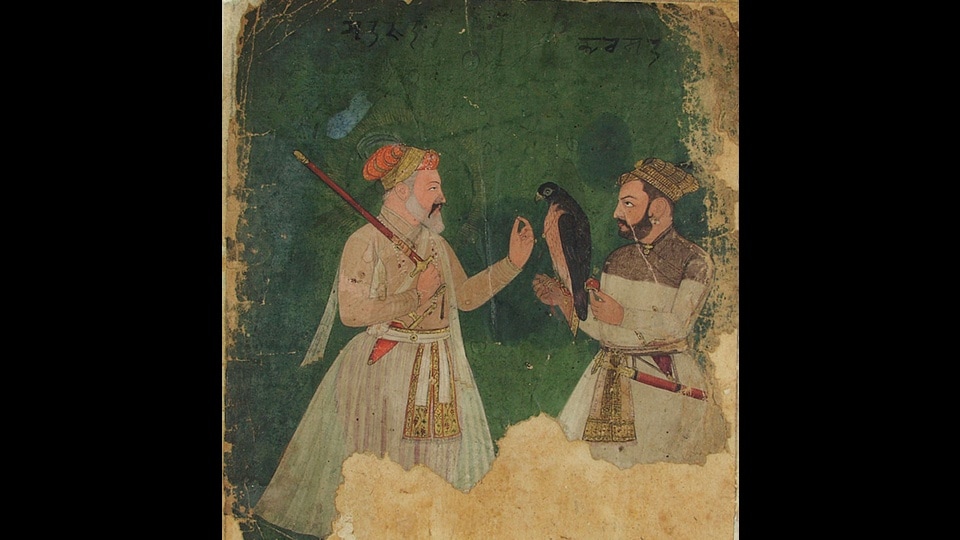
The raptor depicted in the artwork and dated to 1650 AD had been labelled a “sparrowhawk” by the Harvard curators when in all credence it was in resemblance to the Black shaheen / Shaheen falcon. The bird depicted in the artwork exhibits the shaheen’s black and a light cinnamon wash, long wings and short tail, and devoid in evidence of a sparrowhawk’s white throat and horizontal barring on underparts.
The shaheen was renowned for its association with the Mughal nobility and bestowed the title of the ‘King of Birds’ i.e., ‘Shah’ (king) and ‘een’ (bird) in Persian. In contrast, the ‘lowly’ sparrowhawk was held in much less esteem by the Mughal high nobility.
Piqued by this incorrect identification that had evaded notice for decades in a haloed shrine of art, I emailed the museums. I received a response within four hours from Dr Ayşin Yoltar-Yıldırım, who is the Norma Jean Calderwood Curator of Islamic and Later Indian Art at the museums: “Thank you for correcting the bird’s identification in the painting. I have changed it to Shaheen falcon but it may take a few days to refresh”.
Yoltar-Yıldırım was more than true to her words. The necessary ‘refresh’ just took a few hours. The museums’ corrected description now reads: “In this painting, Mughal emperor Shah Jahan (r.1627-1658) receives a Shaheen falcon from Raja Prithvi Singh of Chamba (1641-’64), located in Himachal Pradesh”.

Serpent’s worship of the Sun God
Last Monday, the sun staged an emphatic appearance after days of fog and icy winds. People flocked to the Sukhna lake but they did not contemplate the miracle of the sun in quiet, meditative gratitude. It was left to a Rock python to pay true tribute to the Sun God in the venerable traditions of ‘rishi-munis’ and hermits.
Accomplished birder Lalit M Bansal had shortly digressed from the beaten track on Monday hoping to photograph awakened turtles and birdlife along the lake’s shores. But his sharp eye yielded a spectacle of the natural world granted only to a true seeker. A python of approximately 10 feet had ventured along a long tree branch hanging over the water and was sun basking.
Unlike some human worshippers, who lower their heads in deference to gods and deities, the python had its head raised to the sun. A beautiful, robust and majestic manifestation of Mother Nature in the guise of an ‘ascetic serpent’ was praying to the ‘regent of the solar system’ and in spiritual transcendence with the ‘soul of all life on the blue planet’.
Though basking on ground is the preferred option, pythons scale trees when faced with human interference or that the canopy is too thick to allow sunlight to filter to the floor or undergrowth too dense to afford clear patches of sunlight. Fortunately, the ‘mela of people’ was far too preoccupied in preening before smartphones and staging pretentious Insta reels to spot and bother the python, which was lounging not too far from the popular Sukhna walking trail.
“Basking is the most conspicuous thermo-regulatory behavior that enables pythons to enhance physiological performance, including running speeds, growth, reproduction and digestion. Gravid females spend more time basking than non-gravid females. Basking periods are equally important in the case of male reptiles wherein the spermatogenesis occurs only at a particular temperature,’’ stated a research paper authored by SACON’s Aditi Mukherjee, HN Kumara and late S Bhupathy.
The vjswild2@gmail.com


