The other day, with rains bottling the region, I took a ramble to Siswan dam. Till June, the dam was undergoing de-siltation, which resulted in large pools of imprisoned water when the monsoons set in. By those pools, I came upon fishermen using lines baited with earthworms. The line would suddenly twitch in the placid, ‘dhaba chai-like’ waters as the bait was taken. The fisherman would yank out a squirming fish, smeared scarlet by the hook’s penetration. Exposed, the fish’s dark eyes looked at me with terrified curiosity. We humans must seem to them as extra-terrestrials.
To my astonishment, the fishermen slipped the fish into tiny puddles to keep them fresh. They seemed to breathe easily out of the pools. Mostly they were Spotted snakeheads / Snakehead fish (Channa punctatus), known locally as Dolla machhi. “It is a fish of muddy/marshy waters because it can breathe in air as well due to its possession of accessory respiratory organs or lung-like structures. It is purchased as live fish by retailers as it can survive many hours without water. The government recommends this fish for culture in village ponds,” Onkar Singh Brraich, head, department of zoology & environmental sciences, PU, Patiala, told me later, putting to rest the mystery over the species’s outlandish resilience.
The scene at Siswan, as I contemplated over the destiny of the fish, took my mind to ‘The Trout Quintet’, a work of chamber music composed by the Austrian, Franz Schubert, in 1819. My late father had introduced me to this musical ode to nature. The quintet’s lyrical, melodic flows of the violin and viola evoked a trout’s dashes in European brooks, while the gurgling stream erupted in the piano’s notes. The quintet had captivated me so, especially in the wake of my father’s Brown trout angling expeditions to the sparkling, splashing river that surged past Kangan during dreamy Kashmir summers of the 1970s and 1980s. Each bloodied trout landed, in piteous writhing and bounces, would evoke delighted squeals from us children. The shikar would be buttered and barbecued over a riverside wood fire. Only the river racing by paid a tearful adieu to the charred remains of what were once its glories, its flashes of quicksilver, the enchanted spirits of its sprinting waters.
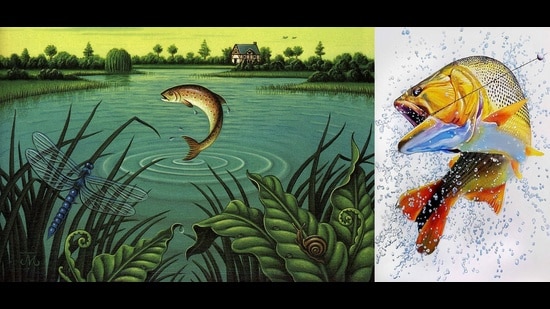
Schubert had initially composed a song in 1817 for a solo voice and piano accompaniment and titled it ‘Die Forelle’ (The Trout). Gazing upon a moody fish dart here and there in the waters, and then have it look back shyly at you, is a spectacle of universal appeal. Die Forelle evoked that elegance: “I stood beside a river, That sparkled on its way, And saw beneath the ripples, A tiny trout at play; As swiftly as an arrow, It darted to and fro, The swiftest of the fishes, Among the reeds below.”
{{/usCountry}}Schubert had initially composed a song in 1817 for a solo voice and piano accompaniment and titled it ‘Die Forelle’ (The Trout). Gazing upon a moody fish dart here and there in the waters, and then have it look back shyly at you, is a spectacle of universal appeal. Die Forelle evoked that elegance: “I stood beside a river, That sparkled on its way, And saw beneath the ripples, A tiny trout at play; As swiftly as an arrow, It darted to and fro, The swiftest of the fishes, Among the reeds below.”
{{/usCountry}}The composer would also watch anglers at their bedeviling lures, and he wrote: “Their scaly bodies writhing with fear and their poor souls gasping and pleading to be thrown back into the stream. I was filled with admiration for the sleek beauty and quicksilver movements of the fish and then melancholy overcame me as I watched them being landed. I tried to instil these emotions into my song, which is a celebration and a lament for the shining lives and frantic deaths.”
The quintet of 1819 was adapted partly from Die Forelle. The text of Die Forelle was itself based on a poem, The Trout, of 1783 by the dissident, Christian Schubart, who had written it while imprisoned by the Duke of Württemberg. The poem is discerned by literary critics as not only a political parable (the dissident ‘twisting on the line’) but a sexual allegory --- of betrayal and cheating, woven artfully into the imagery of the cold-blooded fisherman (seducer) deliberately muddying clear waters to confuse the innocent trout (maiden) and hook her. As Schubart warned: “Beware the anglers’ treason, Else you may bleed too late!”
vjswild2@gmail.com