The work on the excavation of the Zojila Tunnel connecting Kashmir with Ladakh has reached the halfway mark in the Himalayan range despite working in adverse weather conditions, its executing agency Megha Engineering and Infrastructures Ltd(MEIL) said on Monday.
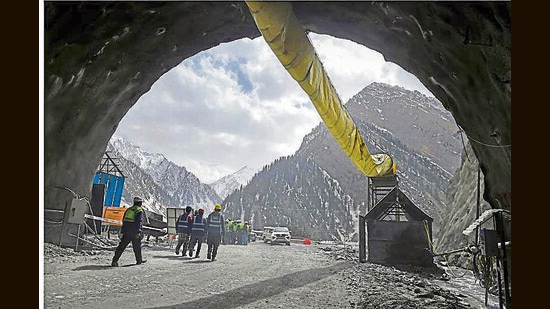
The main tunnel (Zojila Tunnel or T3) is 13 km in length which when completed along with two smaller tunnels (T1 and T2) will provide yearlong connectivity between Srinagar and Ladakh under all weather conditions. It starts from Baltal on the west side and ends at Minamarg, near Drass, on the east side.
The company said that they have completed 7 km of the overall tunnel’s excavation works in one and a half years since the inception of the work. The project also has four bridges with a total length of 815 metres to cross the river on the Zojila route. The substructures and foundations for the bridges are completed.
It said that the tunnel works are being carried out amid heavy snowfall and adverse weather conditions.
“We have achieved what the entire nation thought was impossible. While everyone around Meenamarg, including army personnel, police, medical personnel and locals, have left the place due to very low temperatures during winter, the dedicated workforce of the MEIL stayed on and continued the tunnel excavation works. Everyone is elated with the progress of the work,” said Harpal Singh, project head, MEIL, in a statement.
{{/usCountry}}“We have achieved what the entire nation thought was impossible. While everyone around Meenamarg, including army personnel, police, medical personnel and locals, have left the place due to very low temperatures during winter, the dedicated workforce of the MEIL stayed on and continued the tunnel excavation works. Everyone is elated with the progress of the work,” said Harpal Singh, project head, MEIL, in a statement.
{{/usCountry}}The MEIL said that Asia’s longest bidirectional tunnel will bring down distance and also commute time between the two regions. The travel time currently between Sonamarg and Meenamarg is four hours, while it will drastically come down to just 40 minutes.
The MEIL is executing the project for the National Highways and Infrastructure Development Corporation Limited (NHIDCL), a Ministry of Road Transport and Highways undertaking. The Zojila works were launched earlier by Transport and Roadways Minister Nitin Gadkari.
Singh said that the works on the tunnel were progressing at a very slow place of less than 15 metres in about two years before the MEIL took it over.
“After the MEIL has taken over, it has completed 7 km of excavation works in just a year and a half. Even during peak winter, around 3.5 km of excavation work has been completed,” said Singh.
He said that teams from premier institutions like the IIT-Delhi and IIT-Srinagar visited the works on the project and expressed happiness over the international standards maintained in the execution.
Zojila Pass is the connecting link for the strategic Srinagar – Leh and also with the rest of India. This part of the Silk Route is most crucial for Defence as well as the economy of the region, the agency said.
The company has carried out the works in sub-zero temperatures, especially at minus-40 degrees Celsius, in high altitude. It is, in fact, difficult to execute drilling and civil works in that terrain which has hard rocks and heavy seepage, it said.
The overall project entails construction of a total of 18-km-long tunnels (including T1, T2 & T3) and 17-km-long road, three vertical shafts, four bridges, and other associated structures.
The Tunnel 1 (Nilgrar Tunnel 1) is a 468-metre-long twin-tube tunnel and Tunnel 2 (Nilgrar Tunnel 2) is a 1,976-metre-long twin-tube tunnel. The Tunnel 3 (Zojila Tunnel) is a single tube tunnel which is 13 km in length. The MEIL is also laying a 17-km-long road from Z-morh to Baltal.
The agency said it has completed 40 percent of the road works.
“Laying of a road in the hilly and snowy terrains includes different processes and layers compared to normal planes and plateaus,” it said.
The company has deployed a total of 1,268 advanced and high-end technology machinery and equipment for the execution of the Zojila project. The manpower involved in the project is 2,000 persons, and many other indirect employment opportunities to people.
The MEIL, which began its journey with a small fabrication unit in 1989, has to its credit the completion of the world’s largest multi-stage Kaleshwaram Lift Irrigation Project in Telangana.