E-Paper



Anti-encroachment drive at Delhi’s Tughlaqabad Fort begins
More than 1,000 structures are expected to be cleared in the coming days, said officials.

 Prefer HTon Google


Days after the Delhi high court gave the Archaeological Survey of India (ASI) four weeks to remove encroachments from the Tughlaqabad Fort, authorities led by the agency began a large-scale demolition drive at Bengali Colony in Chhuriya Mohalla on Sunday, targeting semi-permanent structures near the Tughlaqabad village towards the monument.
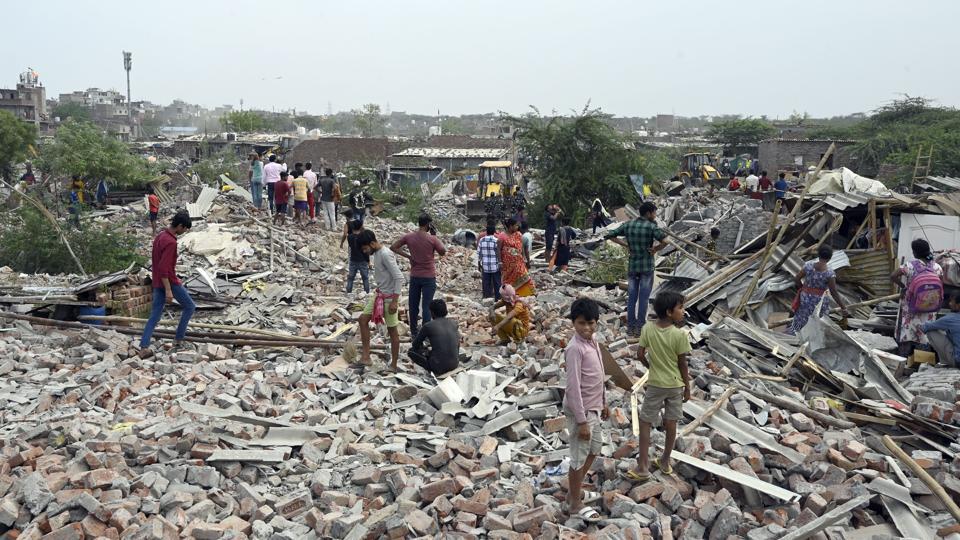
Three excavators were dispatched early in the morning, and at least fifty structures were demolished, officials who participated in the drive on Sunday said, adding that more than 1,000 structures are expected to be cleared in the coming days.
The demolition drive was overseen by district magistrate Isha Khosla, the Kalkaji SDM and senior police officials. Security was increased at the camp, with police and Central Reserve Police Force (CRPF) personnel erecting barricades in each lane and being instructed to maintain security and peace.
HT reached out to Khosla and the ASI, who did not comment on matter. Rajesh Deo, deputy commissioner of police (south-east) said, “We had deployed adequate security to ensure the demolition drive was incident-free. No violence or confrontation was reported.”
According to section 19 of The Ancient Monuments and Archaeological Sites and Remains Act, 1958, the Centre may, by order, direct that any building constructed by any person within a protected area, in contravention of the provisions of the section, shall be removed within a specified period and, if the person refuses or fails to comply with the order, the collector may cause the building to be removed and the person shall be liable to pay the cost of such removal.
In February 2016, the Supreme Court declared the entire Tughlaqabad Fort as protected, and directed ASI to not allow any land-grabbing or encroachment there.
On November 24, 2022, the high court granted six weeks to ASI to remove the encroachments as the “last indulgence”, and on April 24 this year gave the ASI the four-week deadline.
Most of the Bengali Colony residents are from the working class, who make a living as housemaids, factory helpers, drivers, and labourers.
According to Arun Pal, a camp resident, people were given no warning to remove their belongings before the demolition began. “While everyone was given notices a few months ago, they could have at least informed us a day earlier that demolition was taking place. Instead, all of our belongings were destroyed along with the houses. They arrived unexpectedly and began demolishing the houses around noon,” Pal said, adding that he had lived in the area for over 15 years.
Aam Aadmi Party leader Sugandha, the area municipal councillor, said, “We demand that the people who are going to be affected in the drive be rehabilitated.”
Another resident, Utpal Biswas, whose slum was destroyed on Sunday, expressed concern about the future. “Most people in the remaining houses have already begun removing their belongings because bulldozers are expected to return tomorrow. What will become of our families? Some will seek shelter with relatives, while others will seek rented housing in the neighbourhood. RAF quickly removed a few residents who attempted to protest during the action,” he said.