
 E-Paper



SC to Delhi LG, CM: Rise above political bickering
The Supreme Court has urged the Chief Minister of Delhi and the Lieutenant Governor to set aside their political differences and focus on governance. The court has asked them to come to a consensus on the appointment of the next chairperson of the Delhi Electricity Regulatory Commission. The court also considered referring the Delhi government's challenge to a 2023 ordinance giving the Centre control over the state bureaucracy to a constitution bench of five judges. The court emphasized the need for the two constitutional functionaries to work together and find a solution.


The Delhi chief minister and the Lieutenant Governor (LG) must “rise above political bickering” and “get down to the serious business of governance” of the national capital, the Supreme Court observed on Monday, as it asked the two constitutional functionaries to sit together and decide on the next chairperson of the Delhi Electricity Regulatory Commission (DERC).
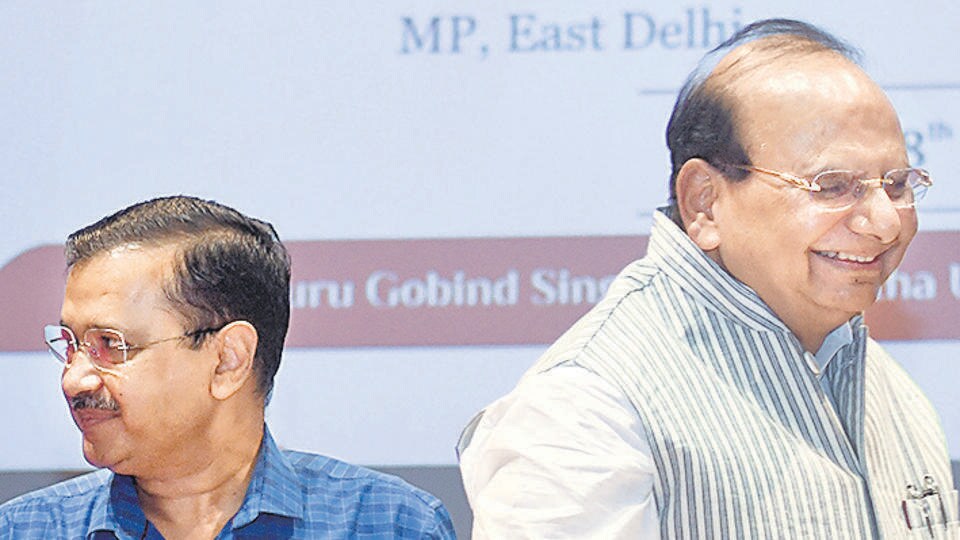
A bench headed by Chief Justice of India Dhananjaya Y Chandrachud also mulled over referring the Delhi government’s separate challenge to the 2023 Government of National Capital Territory of Delhi (GNCTD) Ordinance, giving the Centre control over the state bureaucracy, to a constitution bench of five judges. The Delhi government, on its part, opposed the reference to the larger bench.
“So much work of a government is done away from the glare of publicity and media statements. Both the functionaries must get down to the serious business of governance. We are not so much concerned about the appointment of the DERC chairperson, which we know will be done. We are on the larger issue. If both can sit together, we are certain a lot can be done. We would expect an agreed solution,” the bench said.
The bench, which included justices PS Narasimha and Manoj Misra, was hearing two petitions filed by the Delhi government. The first petition challenged the Centre’s pick for the DERC chairperson while the second disputed the legal validity of the 2023 ordinance. During the hearing, the bench wondered if every dispute between the government and the LG has to be resolved only through a court order.
“We want to know if it is possible to break this impasse. Cannot the LG and the CM, as two constitutional functionaries, sit together and give us a name of a consensus candidate for DERC? You either let the institutions work or you don’t. They have to rise above political bickering,” it remarked.
The court added that had there been a statute authorising the judges of the Supreme Court to appoint a DERC chief, it would have done it. “But we don’t want to step into this and want you two to work it out. Why can’t two constitutional functionaries sit and resolve this?” it asked the senior lawyers appearing for the Delhi government and LG VK Saxena.
Senior counsel Abhishek Manu Singhvi, representing the Delhi government began by contending that it does not seem realistic that two functionaries can arrive at a name unanimously, given the conspectus of the matter. “But I don’t have a problem if they can miraculously agree. We will approach him tomorrow,” he added.
Representing the LG, senior lawyer Harish Salve said that he accepted the court’s suggestion that both the constitutional functionaries must sit across the table and resolve the issue. “It’s unfortunate that the Delhi government lawyer starts by saying that he has no hope. The first reaction should be yes, we will do it,” said Salve.
Fixing the next hearing of the matter on July 20, the bench said: “So long as the objective principle is that you want a competent chairperson, I think you will be able to find one.”
Salve, on his part, said that he was mulling over a public interest litigation that constitutional functionaries should not interact with each other on Twitter and social media. “It should happen like in the old days. They must sit together,” he said.
On July 4, the top court allowed the Delhi government not to proceed on administering the oath of office to justice (retd) Umesh Kumar, who was the Centre’s choice as the new DERC chairperson. On that day, the bench also agreed to examine the validity of Section 45D of the Government of National Capital Territory of Delhi (GNCTD) Ordinance, 2023, under which the appointment order came to be issued on June 21. Section 45D of the ordinance enables the Centre, acting through the LG, to decide on all appointments to all commissions, bodies and authorities in the Capital.
Representing the Centre, solicitor general Tushar Mehta on Monday urged the bench to defer the adjudication on the legality of the ordinance until it is presented in the upcoming session of Parliament, starting July 20. The law officer said that it is still to be seen whether the ordinance provisions are introduced in the same form or with more amendments. “Everyone is adopting a hands off approach right now. Since no prejudicial steps are being taken, this court may defer it till legislative actions are finalised,” Mehta said.
Singhvi opposed the deferment request, arguing that the court cannot be made to wait until the final legislative step is over. “DERC is headless at the moment. The most popular scheme about tariffs is suffering. The political executive of Delhi cannot project its good, bad, neutral policy,” he complained.
Meanwhile, the top court also took up a petition filed by the Aam Aadmi Party government against the Centre’s ordinance, which wrests control from the elected government over services. The ordinance was passed on May 19, a week after the Supreme Court ruled that the Delhi government has control over bureaucrats assigned to departments under its purview.
Through the ordinance, the Centre restored to itself the power over “services” by way of making a raft of major amendments in the Government of National Capital Territory of Delhi (GNCTD) Act, 1991. The ordinance also strengthened the position of the LG, making him the final authority who can act in his “sole discretion” in deciding matters relating to transfer and posting of bureaucrats.
During the hearing on Monday, the bench pointed out that the ordinance seems to have amended Article 239AA, which regulates the executive and legislative powers of Delhi, by resorting to a completely new provision.
“For the first time they have used power conferred under clause 7 of Article 239AA to take services outside the purview of the Delhi government. In a way, the Constitution has been amended. We have to see if it is permissible. I don’t think either the first or the second constitution bench judgement dealt with it. We will have to refer it to a constitution bench,” said the bench.
Singhvi opposed the reference, arguing that the two judgments in 2018 and 2023 explicitly clarified that the Delhi government will have the executive control over all subjects in the State and the Concurrent List, unless specifically excluded by the Constitution. He urged the court to hear him on July 20 for a few minutes before taking a call on the reference to a constitution bench. The court accepted his request.
In a move perceived as nullifying the constitution bench judgment on May 11, the Centre on May 19 introduced a whole new chapter in the GNCTD Act, Part IVA, to create a National Capital Civil Service Authority (NCCSA) and a public service commission for transfers and postings of the officers serving in the affairs of the Delhi government. Delhi, so far, did not have a service commission of its own.
The Delhi chief minister will the ex-officio chairman of NCCSA, stated the amendment, adding that the Delhi chief secretary and its principal home secretary will be the other two members of this permanent authority that will make recommendations regarding transfer, posting, vigilance and other incidental matters of the bureaucrats to the LG, who in turn will take the final decision.
In its challenge to the ordinance, the Delhi government said the Centre’s move shows contempt for the elected government by vesting control over civil servants in the hands of the Union. By conferring wide discretionary powers on civil servants to override the government, the ordinance “in effect and design allows the Union to take over the governance of Delhi”, it added.
The petition while referring to the new body created under the Ordinance said, “though the ordinance feigns a degree of democratic involvement by making stray references to the chief minister, it in fact relegates the chief minister to being a minority voice even in the authority tasked with making non-binding recommendations.”



