E-Paper



Delhi Jal Board: Raw water released to flush Yamuna pollution
DJB’s plants can treat up to 1ppm of ammonia in raw water through chlorination, but beyond this limit leads to the production of toxic compounds.

 Prefer HTon Google


The Delhi Jal Board (DJB) on Tuesday initiated a series of steps to restore the operations of two of the Capital’s largest water treatment plants after ammonia levels in the Yamuna rose on Monday, affecting water supply to various parts of north and west Delhi.
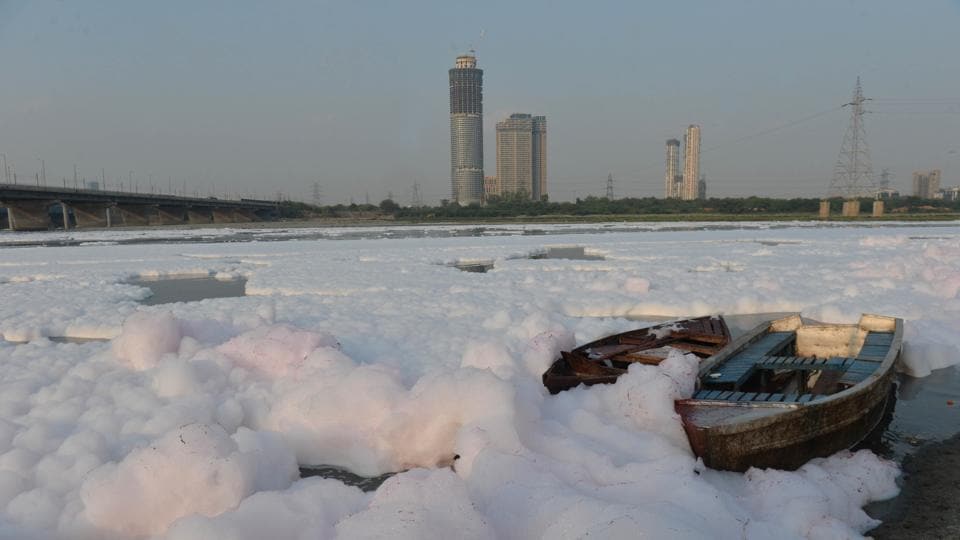
According to DJB officials, ammonia levels at Wazirabad barrage, which feeds the Wazirabad and Chandrawal water treatment plants, were 8.1ppm on Monday night, 6ppm on Tuesday morning and 2.5ppm on Tuesday evening.
Also read: Water supply to be hit in Delhi after spike in ammonia levels
DJB’s plants can treat up to 1ppm of ammonia in raw water through chlorination, but using the chemical beyond this limit leads to the production of toxic compounds. Whenever ammonia levels breach the 1ppm mark, operations at water treatment plants are hit.
A senior Delhi Jal Board (DJB) official said that to bring down the pollutant load on Tuesday, the water utility released water from the holding pond through the barrage to flush out the polluted water from the river. “We are also diluting the polluted water with clean raw water from Carrier Lined Canal (CLC) Munak. Haryana has also released fresh water from other tributaries such as the Somb to flush out the pollutants. We are hopeful that the polluted water will be cleared by Wednesday morning,” he said.
According to DJB officials, the Wazirabad water treatment plant (WTP) was operating at 50% of its capacity, 134 million gallons a day (MGD), and Chandrawal WTP was running at 34% of its capacity (90MGD) on Tuesday morning. DJB said that the plants had returned to normal capacity by late Tuesday night.

Ammonia is indicative of high industrial load or sewage in water. Long-term consumption of water with a high concentration of ammonia can cause poisoning and damage human organs. Symptoms of ammonia poisoning include coughing, chest pain, wheezing, and difficulty in breathing (if the person inhales vapours).
DJB has maintained that the source of the pollutants lies upstream in the Yamuna at Panipat and Sonepat—an annual point of dispute between Delhi and Haryana. “The pollution occurs due to untreated waste water and industrial waste water discharge from Panipat drain DD-1 and DD-2, the Rohtak regulator, and drains DD-6 through DD-8, which reaches Wazirabad barrage and in turn pollutes the Yamuna downstream. Panipat drain 1 and drain 2 carry pollutants from dye industries. Also, DD8 and DD6 drains in Sonepat are vulnerable to contamination as one carries Delhi’s fresh water and other industrial waste,” a DJB official said.
The Haryana pollution control board and the Haryana irrigation department, however, have repeatedly denied the DJB’s allegations.
“Through dilution, flushing of pondage area, efforts are being made to bring the levels under the 1ppm level. Once ozonation plants are installed, the capacity to remove ammonia will go up several times,” an official said, asking not to be named.
Officials added that on Tuesday, the water level of the Wazirabad holding area was 671.9ft against the normal level of 674.5ft while the Wazirabad treatment plant was producing 94MGD water against its usual 134.5MGD capacity. DJB, on average, supplies 956MGD water to 20 million of the Capital’s residents daily and a disruption of each MGD water impacts around 20,000-21,000 people.
Many residents from north and west Delhi complained about disruptions on Tuesday. Pankaj Chaudhary, a member of a residents’ welfare association (RWA) in Bindapur, said that water supply was affected in the area. “DJB should take immediate steps to solve the problem. Residents are suffering and unable to carry out their day to day works,” he added.
Also read: Delhi Metro's 'choice of clothing' statement after viral video of young woman
Deepak Prakash from Old Rajinder Nagar said that the residents in his colony were forced to rely on tankers. “Not a drop of water was supplied today (Tuesday). Hopefully, they will resolve the problem by tomorrow,” he added.
Aniruddha Sharma, a resident of O-block in West Patel Nagar said that no water supply was available in his lane. “The ammonia problem happens every year. Some back-up mechanism has to be developed. How can people be expected to live without water?” he asked.
HT had reported in January last year, that according to data from the Wazirabad water quality monitoring laboratory, the city witnessed 22 ammonia spike episodes over 134 days in 2021, during which ammonia levels were recorded over 1ppm level. To be sure, the problem is witnessed throughout the year, but the concentration of ammonia recorded in winters (between December and March) is relatively higher.
Experts have repeatedly underlined that while Delhi needs to expedite the much delayed upgradation of its water treatment plants, interstate agencies such as Central Pollution Control Board and Upper Yamuna River Board too need to intervene to curb the source of the pollution. Water sector experts have stated that Delhi and Haryana need to work on both the front technological upgrade of water treatment plants and tackling pollution source by better monitoring.