
 E-Paper


Delhi temperatures to rise further, says IMD; likely to cross 35°C by Sunday
Delhi's temperatures are rising, expected to hit 34°C on Wednesday and 36°C by Sunday, while air quality worsens to "poor" amid dry winds.

 Prefer HTon Google


The mercury in Delhi is set to rise again after a brief respite due to cool northwesterly winds. The maximum temperature is expected to reach 34 degrees Celsius (°C) on Wednesday, 35°C on Thursday, and 36°C by Sunday, as per forecasts.
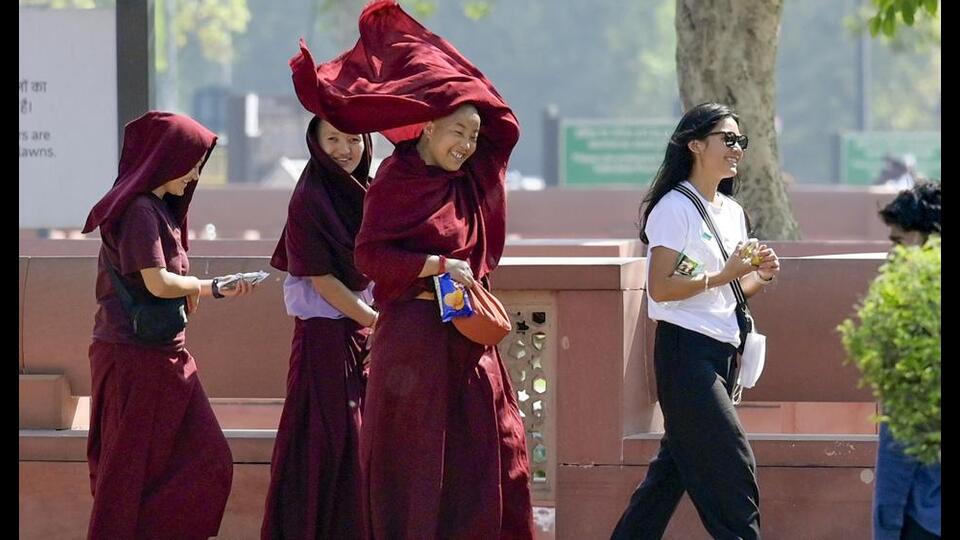
While the India Meteorological Department (IMD) has forecast high wind speed till Thursday, touching 30 km/hr during the day, a change in wind direction, to drier westerly winds will fail to provide any cooling effect, meteorological experts said.
Safdarjung, Delhi’s base station, recorded a maximum temperature at 31.5°C, which was 4°C above normal and up from 30.9°C a day earlier. IMD officials said lack of active western disturbances led to clear skies in the region. “We last saw active western disturbances on January 23 and then on January 27. February only saw weak weather systems developing, which failed to bring any significant rain over Delhi or the larger plains,” said an IMD official, stating only overcast skies were recorded, which controlled the maximum only for a day or two.
ALSO READ | Delhi gets warmer at 31.5 degrees Celsius; temp to go higher on Holi
Mahesh Palawat, vice-president at Skymet Weather, said the change in wind pattern is now playing a role. “While winds briefly touched 25–30 km/hr, the direction has shifted. Earlier, colder northwesterlies prevailed. Now, dry westerlies from Rajasthan and Pakistan are blowing in, leading to a gradual rise in temperature. With winds likely to slow by Thursday, the maximum may cross 35°C,” he said.
The IMD has projected the maximum at 34°C on Wednesday, between 33°C and 35°C on Thursday, and around 36°C by March 8. “A gradual rise of 3-4°C in maximum temperatures is expected over the next seven days,” the IMD official said, adding that surface winds will remain between 15-25 km/hr till Thursday.
So far this season, the highest maximum recorded was 32.5°C on February 28. The mercury has stayed above 30°C for seven consecutive days. IMD data shows that February temperatures were largely above normal, dipping below average only twice – 17.5°C on February 2 and 21.1°C on February 18 – when weak western disturbances brought brief drizzle and cloud cover. The monthly average in February was around 3°C above the long period average (LPA).
ALSO READ | Delhi recorded poorest February air quality in three years, 20 'poor' AQI days so far: CREA
Meanwhile, Delhi’s Air Quality Index (AQI) slipped to 216 on Tuesday, from 193 a day earlier, pushing it back into the “poor” category after two days in “moderate”. According to the Centre’s Air Quality Early Warning System for Delhi, the AQI is likely to hover in the “moderate” range between Wednesday and Friday.
The winds from Rajasthan and Pakistan are drier and often bring coarser dust particles, leading to a spike in PM 10 pollutants locally. Delhi’s air quality, which was in the “moderate” category for two days, deteriorated to the “poor” range on Tuesday.
The Commission for Air Quality Management (CAQM) on Tuesday issued a fresh directive to Delhi, Haryana, Rajasthan and Uttar Pradesh state governments, asking them to roll out a targeted Information, Education and Communication (IEC) framework to curb air pollution across NCR.
The commission flagged that while regulatory and enforcement measures are in place, IEC activities require strengthening and better synchronisation with sector-specific strategies.
CAQM has also asked states to prepare detailed action plans aligned with dominant pollution sources — including vehicular emissions, road and construction dust, municipal solid waste and biomass burning, industrial emissions, thermal power plants and diesel generator sets — and to designate a nodal department for year-round outreach and behavioural change campaigns.


Stay updated with all top Cities including, Bengaluru, Delhi, Mumbai and more across India. Stay informed on the latest happenings in World News along with Delhi Election 2025 and Delhi Election Result 2025 Live, New Delhi Election Result Live, Kalkaji Election Result Live at Hindustan Times.


