E-Paper



Delhi’s smog tower impact too little, too close: Report
At best, roughly 500m away and in a downwind direction, there was an 18% improvement in the amount of dust and ultrafine PM.

 Prefer HTon Google


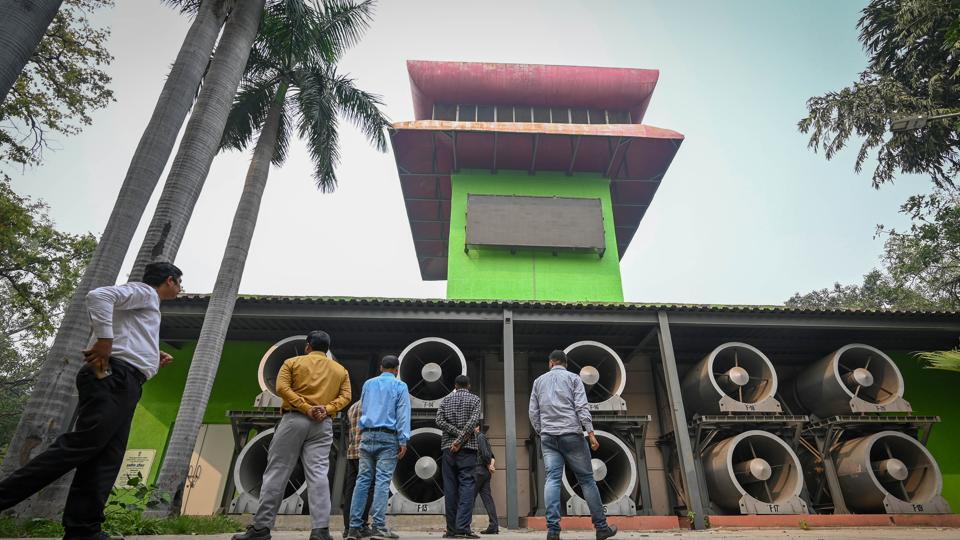
A Delhi Pollution Control Committee (DPCC) team on Wednesday restarted the anti-smog tower at Connaught Place, a day after the Supreme Court ordered the administration to immediately operationalise the 24-metre tall, giant air purifier fitted with fans and an array of filters.
But a report on its efficacy, submitted by IIT-Bombay on September 30, found that only a surrounding area 20m away had the most improvement in air quality, with the gains dropping the farther someone went from it.
Also Read: After SC rebuke, anti-smog tower in Delhi’s CP made functional again
At best, roughly 500m away and in a downwind direction, there was an 18% improvement in the amount of dust and ultrafine particulate matter, but these gains were less in a direction that was upwind from the tower.
HT has seen a copy of the report, which the Delhi government is likely to share with the Supreme Court.
The smog tower at Connaught Place was installed following an apex court order on January 13, 2020 at a cost of around ₹25 crore. The tower was opened by chief minister Arvind Kejriwal in August 2021.
Assuming the report’s 18% reduction assessment as the best case scenario, a back-of-the-hand calculation shows that such a solution is still far from adequate. Take for instance the average PM2.5 concentration in Delhi at 10pm on Thursday, which was at a little over 265.1ug/m3. An 18% reduction would still mean someone standing 500m away from the tower, in the right downwind direction, would still be inhaling roughly 217.1ug/m3 of PM2.5, or roughly 5.4 times what is considered safe quanitites to be exposed to.
Also Read: Want CP smog tower working, orders top court; CM seeks suspension of DPCC secy
Experts said the report underscores that smog towers such as these are not viable, at-scale solutions. “We can use these structures at locations outside hospitals, to simply reduce exposure there, however, this is not a solution to Delhi’s pollution problem. Instead, we need to cut down emissions at source,” said Sunil Dahiya, analyst at the Centre for Research on Energy and Clean Air (CREA).
The IIT-Bombay report also went into the operational challenges involved in running the gigantic air filter. It recommended the facility be activated only in winter months since “it has negligible impact in the summer”, and suggested that future prototypes be scaled down in size, since maintenance was a problem, particularly in terms of filters and cost-efficiency.
Data from the report showed a notable drop in PM10 and PM2.5 concentration primarily at distances of 50m, 70m, and 100m. “A reduction of 40-43% for PM10 and 35-36% for PM2.5 is observed at 50m in the southeast direction. Similarly, in the southeast direction at 70m, a reduction of 33-37% and 30-34% was observed for PM10 and for PM2.5 respectively. At 100m in the northwest direction, a reduction of 8-17% for PM10 and 12-18% for PM2.5 was seen,” it said, in the context of one reading when the winds were from the northwesterly direction.
The institute based its report on a study conducted between October 2022 and February 2023.
Also Read: As Delhi chokes, AAP minister responds to BJP's allegations on smog tower
“Since winter is a season when severe pollution episodes occur (around 350 μg/m3 for PM10) in Delhi and elsewhere, this air cleaning system is indeed useful in providing relief within its zone of influence. In contrast the pollution levels are generally low in summer and rainy seasons (less than the regulatory limits) and hence there is no need for operating it,” the report said, stating it would also reduce its operational costs further.
However, in signalling some assumptions and specifying caveats, the report exposes how futile such towers may be in Delhi at the moment. For instance, the report estimates that 19,500 people will be benefited by the 18% reduction in pollution within a .78 square km radius of the smog tower, but it does not take into account the fact that tower is located next to a main road, and not a packed settlement. It also cautions that high winds or surrounding buildings can impede its efficiency, making its use case extremely limited.
It said there was a need to improve the overall cost-to-performance efficiency, with clogged filters creating air leaks after some time. “It is also recommended that attention be paid towards re-engineering the system to make it more efficient. The cost benefit analysis should also be carried out by considering the installation cost and the cost of operation and maintenance...” the report said, stating there are chances of the filters getting dislodged after being choked with pollutants.
IIT-Bombay also recommended that the overall size of the tower be reduced, noting that its current 24m height is one of the reasons for maintenance issues.
The tower has 40 large fans that draw air from the top of a special canopy structure and release clean air below – each fan is a 25 horsepower motor.