
 E-Paper



India-China ties to stay strained over next year, warns US intel report
The report was prepared in early February and released on Wednesday, as intelligence community leaders offered their assessment of threats to American security interests to the US Congress.

 Prefer HTon Google


Washington: Declaring that China, a “near peer level competitor” of America, has the capability to alter the rules-based order in every sector and across multiple regions, a US intelligence report, released on Wednesday, concluded that ties between India and China will remain “strained” over the next year and the persistent low-level friction at their shared border has the potential to escalate swiftly.
In its annual threat assessment report, the Office of the Director of National Intelligence (ODNI) — the apex of America’s vast intelligence apparatus — flagged two broad strategic challenges to US interests. The first is the strategic competition between the US and its allies on one hand, and Russia and China on the other. The second pertains to shared global challenges, including climate, human and health security.
“These two strategic challenges will intersect and interact in unpredictable ways, leading to mutually reinforcing effects that could challenge our ability to respond,” the report warns.
The report was prepared in early February and released on Wednesday, as intelligence community leaders offered their assessment of threats to American security interests to the US Congress.
India and its challenges
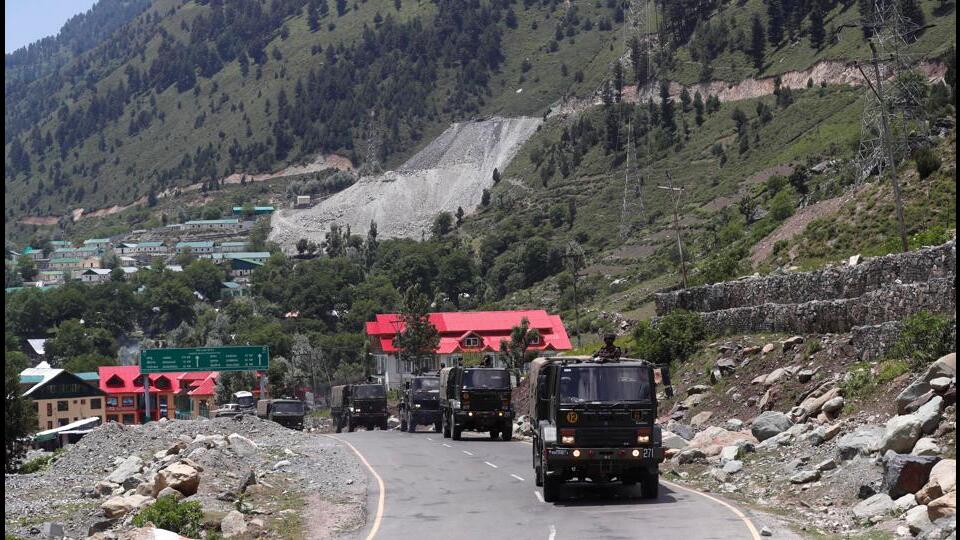
In a section on potential interstate conflicts, the report refers to India-China ties, suggesting that while the two countries have engaged in bilateral border talks and “resolved border points”, relations will remain “strained” in the wake of the 2020 deadly clash, a reference to the skirmish between Indian and Chinese soldiers in Ladakh’s Galwan Valley, along the Sino-Indian border, in June 2020. Twenty Indian soldiers and at least four Chinese troops were killed, the first fatalities along the Line of Actual Control (LAC) in 45 years.
“The expanded military postures by both India and China along the disputed border elevate the risk of armed confrontation between two nuclear powers that might involve direct threats to US persons and interests, and calls for US intervention. Previous standoffs have demonstrated that persistent low-level friction on the Line of Actual Control (LAC) has the potential to escalate swiftly.”
The same section also has a brief reference to the India-Pakistan dynamic, with ODNI warning there remains the risk of an escalatory cycle between the two nuclear armed neighbours.
“New Delhi and Islamabad probably are inclined to reinforce the current calm in their relationship following both sides’ renewal of a cease-fire along the Line of Control in early 2021. However, Pakistan has a long history of supporting anti-India militant groups, and under the leadership of Prime Minister Narendra Modi, India is more likely than in the past to respond with military force to perceived or real Pakistani provocations.”
Growing Chinese belligerence
But the report’s key focus is on China and Russia. ODNI suggests that Chinese President Xi Jinping, in his third term, will “work to press Taiwan on unification, undercut US influence, drive wedges between Washington and its partners, and foster some norms that favour its authoritarian system”. China claims the island of Taiwan as its province and has vowed to reunify it with the mainland, by force if necessary.
The report claims that Beijing is combining growing military power with its economic, technological, and diplomatic influence “to strengthen [Chinese Communist Party] rule, secure what it views as its sovereign territory and regional pre-eminence, and pursue global influence”.
The section on China extensively deals with Beijing’s belligerence and goals in Taiwan, South China Sea, East China Sea, and the use of its Belt and Road Initiative, Global Development Initiative and Global Security initiative as alternatives to the US and West-dominated international development and security frameworks. The report also offers details on China’s military, nuclear, cyber, space, technological, developmental capabilities and its “malign influence” operations.
The US intelligence community has predicted that China will “maintain its diplomatic, defence, economic, and technology cooperation with Russia to continue trying to challenge the United States even as it will limit public support”. Moscow and Beijing forged a deeper strategic understanding in February 2022, and in recent weeks, the US has warned that Beijing is considering providing lethal arms support to Moscow for its war in Ukraine while acknowledging that China hasn’t done so yet.
Russian provocations
The threat assessment says that Russia’s war in Ukraine is a “tectonic event” that is reshaping Moscow’s relationships with the West and China, and more broadly in ways that are unfolding and remain highly uncertain. It warns that an escalation of the conflict between Russia and West carries a greater risk, “which the world has not faced in decades” and claims that Russia will continue to pursue its interests in “competitive and sometimes confrontational and provocative ways”.
On Ukraine itself, ODNI claims that Russia’s operation has not yielded the outcome that President Vladimir Putin had hoped for. It attributes to Putin miscalculating the ability of the Ukrainian armed forces and suggests that Russia will continue to face “issues of attrition, personnel shortages, and morale challenges”.
But it also says the full effects of Russia’s partial mobilisation may be seen in the spring and summer of 2023, and while Russia will continue to focus on Donbas, Moscow will “probably” not be able to take all of the region this year.
The war has also diminished Russian capabilities, US believes, with the report claiming, “Moscow’s military forces have suffered losses during the Ukraine conflict that will require years of rebuilding and leave them less capable of posing a conventional military threat to European security, and operating as assertively in Eurasia and on the global stage.” But it offers a reminder that Russia maintains the “largest and most capable nuclear weapons stockpile and..continues to expand and modernise its nuclear weapons capabilities”.


