Gurugram and other southern Haryana cities have breached the permissible annual limit for PM10 for seven consecutive years, data from the Centre for Research on Energy and Clean Air (CREA) showed. While levels differ across cities, all of them remain well above the national standard.
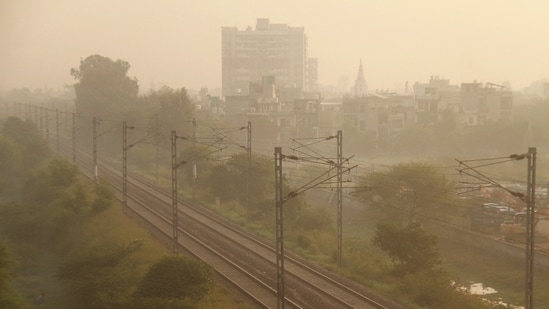
PM10 are tiny – 10 micrometres or smaller in diameter – airborne particles such as dust, soot and smoke that can be inhaled into the respiratory system. Generated largely from sources like construction activity, road dust and vehicle emissions, these particles can aggravate respiratory illnesses.
According to the data, Gurugram recorded an annual PM10 of 164.9 µg/m³ in 2026 (as on October 23) against the prescribed annual limit of 60 µg/m³. The level has stayed high since 2019, when it was 190.2 µg/m³. It dropped to 148.4 µg/m³ in 2020, before climbing again to 196.7 µg/m³ in 2022; it stood at 159.6 µg/m³ in 2025.
Ballabhgarh recorded an annual PM10 of 195.1 µg/m³ and Faridabad 144.1 µg/m³; Dharuhera and Manesar (both industrial areas) recorded 123.9 µg/m³ and 121.2 µg/m³, respectively after significant spikes in 2025. Dharuhera had hit 277.8 µg/m³ and Manesar 196.7 µg/m³ last year.
Bhiwani and Palwal also stayed above the annual standard so far this year, at 91.9 µg/m³ and 79.8 µg/m³, respectively.
{{/usCountry}}Bhiwani and Palwal also stayed above the annual standard so far this year, at 91.9 µg/m³ and 79.8 µg/m³, respectively.
{{/usCountry}}Experts said exposure to PM10 can irritate the airways, worsen asthma and other respiratory conditions, and reduce lung function. Children, older adults and people with pre-existing ailments are at particular risk.
“Local mitigation measures have had limited impact because implementation is often inconsistent, and interventions such as mechanised sweeping and water sprinkling do not address the underlying causes of dust generation. Poor road conditions, unpaved shoulders, construction activity and the movement of vehicles continue to generate and resuspend dust. Construction dust regulations and GRAP measures also need stronger enforcement,” Dr Manoj Kumar, an analyst at CREA, told HT.
Earlier this week, the Centre invoked Stage I of the Graded Response Action Plan or GRAP across the capital and NCR. This came after Delhi recorded its first 'poor' air quality day of the season on Wednesday, with the Air Quality Index touching a 100-day high of 245.
Under Stage I of GRAP imposed by the Commission for Air Quality Management (CAQM), authorities will strengthen dust-control measures at construction sites, prevent open burning of garbage and biomass, check vehicles for valid Pollution Under Control (PUC) certificates and act against visibly polluting vehicles and overage petrol and diesel vehicles.
Inter-city and inter-state buses from specified states, including Haryana, Uttar Pradesh and Rajasthan, cannot operate in Delhi-NCR unless they are electric, CNG-powered or BS-VI diesel buses.
Authorities must also intensify inspections of industries, brick kilns and hot-mix plants, improve traffic flow, ensure mechanised road sweeping and water sprinkling, and prevent fires at landfill and dumpsites.