The Gurugram Metropolitan Development Authority (GMDA) has prepared a ₹5.88-crore plan to install flow meters, surveillance cameras and online water quality analysers across the city’s primary storm-water drains to identify sources of untreated sewage and chemical-laced industrial effluents entering the Yamuna, senior officials aware of the matter said.
The project will cover Master Storm Water Drain (SWD) Legs I, II, III and IV, alongside the Manesar Drain, and is targeted for completion by January next year. According to the tender document released by GMDA’s stormwater drainage wing on Thursday, seen by HT, the selected contractor will install and commission the equipment within three months, followed by five years of operation and maintenance (O&M).
The authority plans to install 10 non-contact radar level sensors with surface velocity sensors, 10 solar power systems and 10 pan-tilt-zoom (PTZ) surveillance cameras with 40-day cloud backup. Six online water quality analysers will provide real-time readings of Biochemical Oxygen Demand (BOD), Chemical Oxygen Demand (COD), Total Suspended Solids (TSS) and pH. Data will be integrated with the GMDA command system and Haryana State Pollution Control Board (HSPCB) portal through Application Programming Interfaces (APIs).
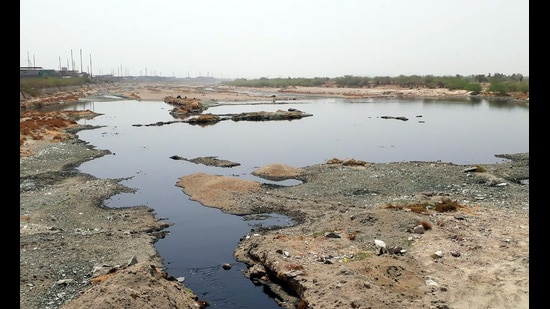
The move comes amid the National Green Tribunal (NGT) directions restricting untreated discharge into the Yamuna. HSPCB estimates in April showed nearly 150 million litres per day (MLD) of untreated municipal sewage and toxic industrial effluent entering the Yamuna from the district. The NGT subsequently directed the Haryana chief secretary to formulate immediate interventions.
{{/usCountry}}The move comes amid the National Green Tribunal (NGT) directions restricting untreated discharge into the Yamuna. HSPCB estimates in April showed nearly 150 million litres per day (MLD) of untreated municipal sewage and toxic industrial effluent entering the Yamuna from the district. The NGT subsequently directed the Haryana chief secretary to formulate immediate interventions.
{{/usCountry}}“These automated devices will allow us to map the volume of wastewater entering the drains as well as identify the specific catchment clusters or industrial belts responsible for high pollutant loads,” a senior GMDA official said, requesting anonymity. “Once the baseline telemetry data is generated, GMDA, in coordination with MCG, MCM, HSVP, and HSIIDC, will initiate targeted action against erring units and plug illicit sewer connections.”
The flow meters and analysers will help authorities identify the points or catchment areas from where polluted water is entering the drains, following which teams will trace the discharge upstream to specific sewer connections, industrial units or STPs. Officials will then check whether the STPs at the identified points are functioning properly and releasing treated water into the drain and take corrective action against illegal connections or other violations.
Officials said the equipment will be placed at critical intercept points and will also help identify blockages early, allowing emergency teams to deploy mobile pumps before low-lying intersections inundate.
Stay updated with all the Breaking News and Latest News from Mumbai. Click here for comprehensive coverage of top Cities including Bengaluru, Delhi, Hyderabad, and more across India along with Stay informed on the latest happenings in World News.
Stay updated with all the Breaking News and Latest News from Mumbai. Click here for comprehensive coverage of top Cities including Bengaluru, Delhi, Hyderabad, and more across India along with Stay informed on the latest happenings in World News.