
It was supposed to be a “green” Diwali in Gurugram, the kind with NEERI-certified crackers, two-hour bursting windows, and promises of clean celebration. Instead, the Gadoli cracker market on Diwali eve told a very different story. Stalls overflowed with smoke, streets jammed with honking cars, and banned fireworks were sold openly as enforcement looked the other way.
Standing amid bursting anars and the thick smell of sulphur, it was clear that law and order had taken the night off. The air reeked not of festivity but of negligence. “Dikhane ke liye green hai, chalane ke liye asli hai,” one shopkeeper said with a grin. (They look green, but they burst like the real ones.) His stall, like many others, displayed “GREEN CRACKERS ONLY” banners while selling sutli bombs and ladis in bulk.
Police presence was largely symbolic. One officer, seated inside a godown with his cap off and a cup of tea in hand, watched casually as sparks flew nearby. When asked if any checks were underway, he replied, “Madam, yeh Diwali hai, enforcement nahi.” Traders echoed the same sentiment.
Licences, they said, arrived just two days before the festival — “too late for paperwork, just in time for business.” Improvisation became the norm. One seller had converted his living room into a storage space, while another hid cartons of banned rockets in a back alley. “Raids? On Diwali? Who will spoil their festival?” he said, laughing.
{{/usCountry}}Licences, they said, arrived just two days before the festival — “too late for paperwork, just in time for business.” Improvisation became the norm. One seller had converted his living room into a storage space, while another hid cartons of banned rockets in a back alley. “Raids? On Diwali? Who will spoil their festival?” he said, laughing.
{{/usCountry}}The market drew crowds from across NCR. Families from Noida, Ghaziabad, and Delhi came looking for “real” crackers — the kind long banned in their cities. A young couple from Indirapuram, carrying bags of fireworks and a baby, said, “We drove three hours. Worth it. These make real Diwali sound.” Meanwhile, boxes of certified “green crackers” remained unsold and unwanted.
By 8pm, traffic outside Gadoli cracker market froze for nearly two kilometres. Horns blared as people shopped directly from open car boots. The smoke thickened, and residents peered from balconies, coughing. “Every year, we complain. Every year, it gets worse,” said an elderly local. “Even my neighbour’s dogs stopped barking. He’s given up.”
By 9pm, the market resembled a scene of collective denial. Traders said it was their livelihood, customers said it was “just one night”, and police said they were “short-staffed”. No one felt responsible.
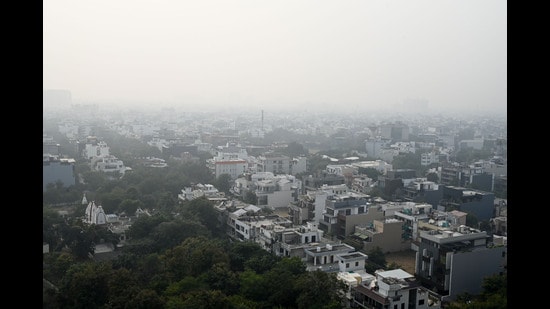
As fireworks lit the Gurugram skyline, the spectacle looked beautiful from afar but toxic up close. The city that often speaks of pollution awareness seemed to celebrate defiance instead. “We preach awareness, yet celebrate apathy,” I observed. “We curse the air, yet light the fire.”
In the end, Gurugram didn’t just light up the sky this Diwali — it exposed itself. The city that talks endlessly about pollution proved once again that when profits, pleasure, and pride collide, rules burn first. The night revealed a city that thrives on chaos, polishes its excuses, and calls it tradition.
ABOUT THE AUTHOR
Leena Dhankhar is Senior Editor and Bureau Chief, Gurugram, at Hindustan Times, where she has spent over 17 years chronicling the transformation of one of India's fastest-growing urban regions. From starting her career as a crime reporter to leading the Gurugram bureau, her journalism has been defined by investigative reporting, in-depth storytelling and an unwavering focus on public interest. Over nearly two decades, she has reported extensively across crime, politics, civic governance, elections, real estate, environment, courts, sports, education and entertainment, covering Gurugram, Faridabad, Nuh and Palwal. Her reporting has exposed several major scams and systemic failures, including insurance frauds, waste management irregularities, illegal arms manufacturing units in Nuh, illegal mining in the Aravallis, organised crime networks and governance lapses affecting millions of residents. Known for her investigative work and exclusive stories, Leena has reported on high-impact national issues, including the Nicaragua charter flight carrying Indian migrants that was turned back amid allegations of human trafficking, exposing the growing network of illegal immigration rackets. Her work has also focused on gang wars, prison administration, juvenile crime, women and child protection systems, the functioning of the Juvenile Justice Board and Child Welfare Committee, and environmental challenges such as pollution, waterlogging and deteriorating civic infrastructure. Beyond hard news, Leena has extensively documented Haryana's rich heritage, forests and wildlife, bringing attention to the state's historical landmarks, biodiversity, conservation efforts and ecological challenges through immersive reportage and feature writing. Her journalism has consistently gone beyond breaking news. She has documented Gurugram's rapid urbanisation through long-form narratives and enterprise reporting on issues ranging from pothole-ridden roads, flooding and waste management to the changing social fabric of India's Millennium City. She also writes widely read feature columns, including The Outsider, Changemaker, and Concern for Gurugram, profiling people, places and ideas shaping the city's identity. Leena is the author of Gurugram School Murder, published by Juggernaut Books, a deeply reported account of one of India's most high-profile school murder investigations. She is currently working on her second book, an investigative work exploring some of India's most significant scams and fraud investigations. Beyond print journalism, she has expanded her storytelling through public speaking and digital media. She is a TEDx speaker and has produced podcasts exploring Gurugram's transformation, civic challenges and untold stories. Her work reflects a commitment to narrative journalism that combines rigorous reporting with compelling storytelling. A law graduate with an MBA in Human Resources, Leena brings a multidisciplinary perspective to her reporting, particularly on governance, public policy and legal affairs. She has travelled extensively across India to pursue investigative assignments, often reporting from remote locations and conflict-prone areas in search of stories that matter.
Stay updated with all the Breaking News and Latest News from Mumbai. Click here for comprehensive coverage of top Cities including Bengaluru, Delhi, Hyderabad, and more across India along with Stay informed on the latest happenings in World News.
Stay updated with all the Breaking News and Latest News from Mumbai. Click here for comprehensive coverage of top Cities including Bengaluru, Delhi, Hyderabad, and more across India along with Stay informed on the latest happenings in World News.