Time travel is a science fiction but it is very much visible in Nanpara in Uttar Pradesh’s Bahraich district. Within a distance of a few kilometres, thousands of residents across several villages of this region do a near time travel from today’s age of mobile phones and internet to the past when these facilities were not there.
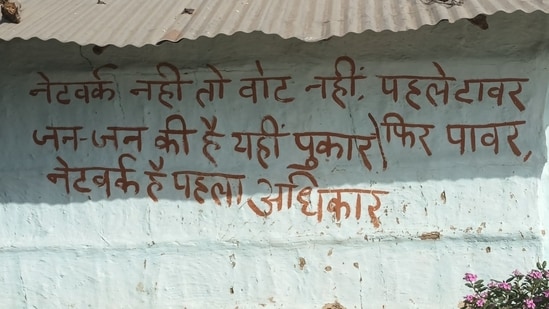
Little doubt then, getting a mobile tower in their villages has become the biggest poll issue for the residents of this ‘pre mobile phone era region’. Amba, Bisnapur, Fakirpur and Bardia besides other some other such villages are located around 64 km from Tehsil office in Nanpara town and just a few kilometres from the Indo-Nepal border.
Residents of these villages stand united in drawing attention to their one-of-its-kind demand. From thatched walls of the houses to banners hung across the polls, slogans like “Tower nahi to power nahi” and “Jan jan ki hai yahi pukar, network hai pehla adhikar” are easily visible.
Also Read | A BJP bastion breached only once in more than 3 decades
As the Hindustan Times team entered these villages, a contrast of life with a mobile phone and one without it is clearly evident. For instance, a local Rajesh is out to catch up on the latest political buzz online. While he looks around for a decent internet spot walking around a kilometre before he gets it, others in the village and neighbourhood embark on long journeys just to get online, such slow is the speed of the network-- now there, now not there.
{{/usCountry}}As the Hindustan Times team entered these villages, a contrast of life with a mobile phone and one without it is clearly evident. For instance, a local Rajesh is out to catch up on the latest political buzz online. While he looks around for a decent internet spot walking around a kilometre before he gets it, others in the village and neighbourhood embark on long journeys just to get online, such slow is the speed of the network-- now there, now not there.
{{/usCountry}}The attention is also drawn towards the village skyline that is dotted with multiple bamboo polls mounted with a small triangular box. Queries about it reveal that they are booster devices for enhancing the mobile phone signals. In a desperation to ensure that the devices work efficiently, they are fixed to bamboo polls with the hope that higher they are the better they will work.
However, these improvisations too have not been effective as search for a decent signal continues to force the residents to walk out of the villages. These villages under gram panchayat Amba in Mihipurwa development block collectively have 9200 voters with a fair share of tribal population with maximum 95% in Bisnapur and around 10% in Amba.
Tribals mostly are from Tharu community recognised as scheduled Indian tribe. They are ethnic group indigenous to Terai in Nepal and parts of India. Explaining how poor network hampers their everyday life, Ramesh says, “We don’t receive any call the entire day. No matter how important a message is there for us, we will get the call or message only if we walk out of the village or if net is connected at any point in village sometimes.” As per him, good network is about 1.5-km away from the village.
Bisenpur has 1,800 voters, Fakirpur has 2,400, Bardia has 2,600 and Amba has 2,400 voters majority among whom are Tharu and Bot along with Muslim and Yadav. Politicians hardly visit these villages but villagers’ issue is common. “If you need 112 ambulance, you can’t call it. Hence, almost all pregnant women, injured villagers and sick people go to health centre by private vehicles. Often a two-wheeler is used in emergency cases,” Amba village head Ikrar says.
“Similarly, in case of a tiger attack, we can’t inform the forest department through phone. It is only after one of us goes to the range office and informs the forest officials that we get help,” Ikrar adds. Wall writings have been done at several places and flex banners have been put up by villagers stating without getting network, they won’t go to vote.
“Almost every voter has exercised their franchise in past elections and they will vote this Lok Sabha 2024 too. The wall writing is just anger of villagers. I am convincing villagers not to abstain from election process and administration has also assured us of a solution. Hopefully, all voters will use their suffrage as in the past,” said the village head.
Ram Prakash Yadav, who runs an internet shop in the village market, says, “Despite booster, it takes much time before a document opens for uploading applications such as that of old age pension or ration card. If network improves, our lives will be better.”
“Even schoolchildren who may learn via free online classes are deprived of the same,” said Khan who uses a smart phone and watches news on it. “The internet came after a gap of three days just before the election rally I wanted to see began. It may go poor any moment,” he said.
According to industry data (May 2023) the tele-density (number of telephone connection per 100 population) in Uttar Pradesh is 65.94 while in India it is 84.40. The rural tele-density in India is 58.92%. But in this village that has at least one smartphone in each house, the usage is very poor.
“The booster is ordered online and with simple method it is installed. The booster enhances net speed and connectivity within a maximum 10-mt radius. One booster works for only one cellphone company network,” said Yadav.
A home-based booster
A small triangle shape white plastic fitting on top of a bamboo stick is connected via wire to a box placed inside the house. This box also helps increase net speed. (With inputs from Shariq Rais Siddiqui)