E-Paper



Agra air quality hovers between poor to severe, Taj Mahal bears brunt
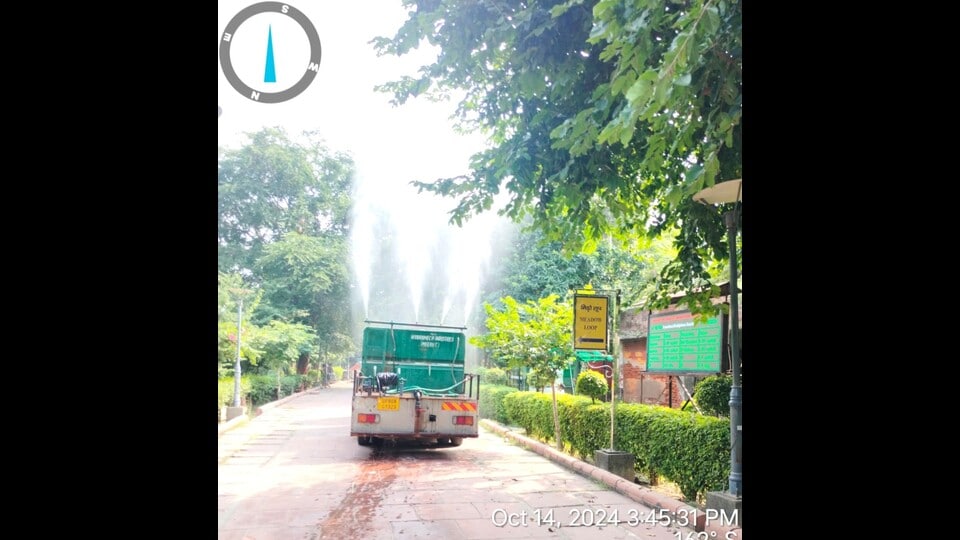
“The Agra Nagar Nigam has stepped up measures in view of rising pollution level . Mechanical sweeping machines and water sprinklers are being used . Those violating norms during construction are being penalised,” informed Ankit Khandelwal, municipal commissioner.

 Prefer HTon Google


Agra The air quality here has been ranging from poor to severe and the world renowned Taj Mahal seems to be under severe attack of particulate matter with sand particles of PM10 level to an alarming level on Monday. Even though winter yet to set in fully, the coming days are likely to be more polluted, harmful to both humans and the Taj .
Among the six pollution monitoring centres of Central Pollution Control Board here , the one at Shahjahan Garden remains in focus because it records pollution level in the area housing the Taj Mahal.
On Monday, the maximum level of particulate matter of PM10 size rose to 435 which is considered to be the worst and termed ‘severe’, affecting healthy people and having serious impacts on those with comorbidities . Minimum level was 59 and average was 102 or moderate on Monday.
There was no respite on Tuesday and although the maximum that the PM10 particulate matter touched was 249 (which again was poor), the finer particulate matter or PM2.5 level touched maximum of 332 in the category of very poor with average remaining on 134 or moderate.
On Wednesday, PM2.5 level touched maximum of 247 while PM10 rose to level of 285 as maximum and both touched ‘poor’ category .
Dr Vipul Kumar, scientist in Central Pollution Control Board admitted that with winter yet to arrive, the wind flow was decreasing further leading to calmer conditions causing less dispersion of particulate matter or sand particles and inviting more downward movement of smog which at one point of time, mostly around Diwali , even caused the Taj Mahal to disappear from sight.
“Any abnormal rise in particulate matter is a cause of concern but it is PM100 or bigger size particulate matter which is more of a threat to the surface of the Taj Mahal because of the abrasion it causes. Suspended particulate matter (SPM) of size PM100 is a real threat of abrasion for marble surface and is monitored at Taj Mahal besides the level of gases. The particulate matter PM10 or PM2.5 is more of a concern for the health of humans,” Dr Vipul Kumar said.
Noted environmentalist and convenor of River Connect, Brij Khandelwal said, “PM100 and gases are monitored but it is a fact that smaller particulate matter or clay material of category PM2.5 and PM10 sticks to the surface of the Taj Mahal and causes visual pollution which makes Taj look yellow. Any excess of particulate matter, of whatever size, is a cause of concern and thus a long term solution is to ensure water in river Yamuna flowing at the back of the Taj Mahal.”
“The Vardarajan Committee, in its report, had suggested sprinklers driven by solar pumps on surface of river Yamuna having sufficient water so that humidity generated would absorb particulate matter of any kind and ensure longer life for Taj,” he said.
A scientist at CPCB said such rise may be because of some random disturbing factor . The road traffic and construction work for Agra Metro Rail project were two major factors believed to be the reason although covering by green net was made mandatory to constriction sites here, he said.
Officials here are now focusing on factors leading to rise in level of particulate matter which include damaged roads, traffic emission, roadside dust and improper disposal of municipal waste or burning of garbage . The area around Taj Mahal has hotels and restaurants where cleaning for Diwali is on. This being the tourism season , the inflow of tourists and their vehicles is also on the rise.
“The Agra Nagar Nigam has stepped up measures in view of rising pollution level . Mechanical sweeping machines and water sprinklers are being used . Those violating norms during construction are being penalised,” informed Ankit Khandelwal, municipal commissioner
‘I have also appealed to denizens in Agra not to add to pollution to city air by burning waste removed from their shops and houses in days ahead of Diwali. Such waste should be handed over to those coming for door to door collection. Yet if anyone is found burning waste in open, will be penalised’ said municipal commissioner Khandelwal.