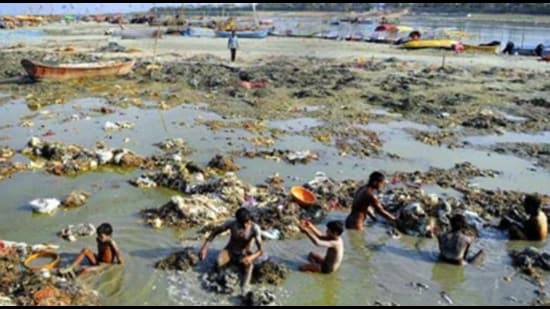
LUCKNOW With eight weeks to Mahakumbh-2025, the National Green Tribunal (NGT) has raised serious concerns over the deteriorating quality of water in the Ganga, citing discharge of untreated sewage into the river. Pulling up the state government, the tribunal has sought an affidavit from the chief secretary within four weeks on the steps taken to address the issue.
The tribunal wants the state to ensure that all sewage treatment plants (STPs) are functional and comply with specific norms. The UP chief secretary, in his next affidavit, will also disclose steps taken/proposed for making the non-functional STPs functional and for ensuring that all plants comply with specified norms, stated the NGT in its order.
“Monitoring of water quality at 41 locations discloses that the faecal coliform exceeds 500MNP/100ml at 16 locations and more than 2500 MNP/100ml at 17 locations, showing that water quality is deteriorating due to discharge of sewage/sullage into the river,” the NGT observed in its order, which HT has access to.
“Out of 326 drains mentioned in the Central Pollution Control Board (CPCB) report, 247 are untapped and discharging 3513.16 MLD waste water into river Ganga and its tributaries,” stated the NGT in its order on November 6.
Taking note of the compliance report filed by the UP Pollution Control Board (UPPCB) on October 30, the NGT pointed towards a report by Central Pollution Control Board submitted on October 22, which exposed the poor management of STPs in 16 Ganga front towns, including Kanpur and Prayagraj.
{{/usCountry}}Taking note of the compliance report filed by the UP Pollution Control Board (UPPCB) on October 30, the NGT pointed towards a report by Central Pollution Control Board submitted on October 22, which exposed the poor management of STPs in 16 Ganga front towns, including Kanpur and Prayagraj.
{{/usCountry}}“In Prayagraj alone, sewage treatment capacity is 394.48 MLD while the sewage generated is 468.28 MLD, leaving a gap of 73 MLD of untreated sewage,” NGT observed. Mahakumbh is slated to begin in Prayagraj on January 13.
According to the details of 41 STPs in 16 Ganga front towns, with designed capacity of 1338 MLD, 35 are operational with a capacity of 1301.2 MLD, with utilised capacity of 1116.23 MLD only. In Farrukhabad, two STPs are non-operational leading to discharge of untreated sewage into the Ganga, the NGT pointed out.
A senior officer said that chief secretary Manoj Kumar Singh had conducted a review meeting in Prayagraj for the steps that the state government has to take keeping in view NGT directives. “The needful will be done in accordance with NGT directives and CPCB report,” said the officer.
Major observations by the NGT
* 41 STPs with designed capacity of 1338 MLD
* 35 operational STPs with operating capacity of 1301.2MLD and utilised capacity of 1116.23 MLD
* 12 STPs complying with faecal coliform norms (less than 230MNP/100ml)
* 23 STPs non-complying with faecal coliform norms (more than 230 MNP/100ml)
* 13 STPs operating at over capacity
* 11 STPs under construction
* In Kanpur, Baniyapur STP completed but not commissioned since three years
* 2 STPs in Farrukhabad non-operational, leading to discharge of untreated sewage water into the Ganga