Ahead of the 2027 Uttar Pradesh assembly elections, the BJP government in the state is mulling over a financial assistance scheme for women, who constitute about 45% of the voters, on the lines of schemes announced by the Bihar, Delhi, Madhya Pradesh and Maharashtra governments, according to people familiar with the matter.
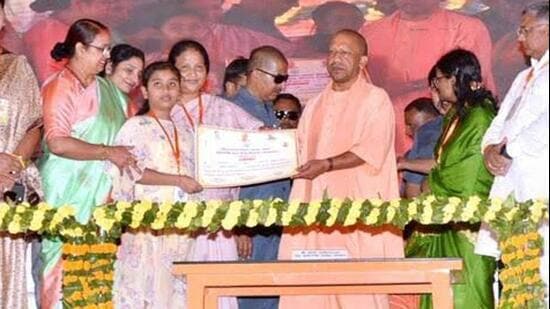
Signalling a fight for women votes between the BJP-led NDA and the Samajwadi Party-led INDIA bloc, the reported move has led to SP chief Akhilesh Yadav repeating his pledge that his party would begin with ₹40,000 yearly assistance for women, with annual increases.
When asked if the government is planning a financial assistance scheme for women before the assembly elections, Uttar Pradesh finance minister Suresh Kumar Khanna said women empowerment has been the top priority for the BJP-led NDA government in Uttar Pradesh.
“If there is a demand from women organisations, the state government will definitely consider it and take required measures in that direction,” he said.
“In its election manifesto, the BJP had made it clear the government would work for the economic and social uplift of women,” he said.
Though Khanna did not give details of the financial assistance scheme, sources said the Uttar Pradesh government is considering offering up to ₹50,000 to women ahead of the 2027 assembly elections.
{{/usCountry}}Though Khanna did not give details of the financial assistance scheme, sources said the Uttar Pradesh government is considering offering up to ₹50,000 to women ahead of the 2027 assembly elections.
{{/usCountry}}“Under the proposal, an initial installment of ₹20,000 will be deposited in the accounts of women followed by three instalments of ₹10,000 each if the NDA returns to power after the assembly election,” the sources said.
The focus will be on women voters from economically weaker sections, lower-income households as well as those belonging to Scheduled Caste, Scheduled Tribe and Below Poverty Line families. Though the eligibility criteria is being finalised, the families below the ₹8 lakh-12 lakh per annum bracket are likely to be included in the beneficiary scheme, the sources said.
Uttar Pradesh has 133,984,792 voters, including 73,071,061 (54.54%) male voters, 60,909,525 (45.46%) female voters and 4,206 (0.01%) third gender voters, according to the final voter list published by the Election Commission of India on April 10 after the Special Intensive Revision (SIR) of electoral rolls. There are 1,763,360 (1.32%) first-time voters in the age group of 18-19 years.
For his part, Khanna said, “The state government has launched a slew of schemes, including Mukhyamantri Kanya Sumangala Yojana, Rani Lakshmibai Mahila Evam Bal Samman Kosh, Mukhyamantri Samuhik Vivah Yojana, Women Self Help Groups, Lakhpati for the economic empowerment of the women. Under Mukhyamantri Kanya Sumangala Yojana, around 28 lakh (2.8 million) women have benefited. Our government has given ₹25,000 in six instalments for women’s education.”
“We have been working for women empowerment since the formation of the BJP government in 2017 in UP. We are giving ₹1 lakh to women under Mukhyamantri Samuhik Vivah Yojana,” he added.
“Empowerment of women is not an election agenda for us. Women reservation is also on top of the BJP’s agenda. Women will not be taken in by the Samajwadi Party which has been changing its stand,” Khanna said.
“The SP government did nothing for women when it was in power from 2012 to 2017. The INDIA bloc misguided the people over the reservation issue during the 2024 Lok Sabha election but they will not be able to take people for a ride in the assembly election,” he said.
Reacting to reports that the BJP was considering a plan to give financial assistance to women in the state, Samajwadi Party national president Akhilesh Yadav dismissed it as another hollow election slogan and countered it by repeating his pledge that his party would begin with ₹40,000 yearly for women, with annual increases.
Accusing the ruling party of relying solely on money to win polls, Yadav, in a post on X on Thursday, claimed the funds were “ill-gotten gains” that “religious and aware women of UP will never accept.”
He alleged that similar cash promises in other states had led to delays in disbursement, recovery demands, and police action against women unable to repay.
He argued the BJP government could have provided such support over the past decade but instead spent thousands of crores on publicity.
He calculated that ₹ 50,000 annually over 10 years would amount to ₹5 lakh and said the ₹ 20,000 proposal would be only 4% of that amount.
“Even if they give ₹20,000, the public is still owed ₹4.8 lakh,” he wrote.
In December 2025, Akhilesh Yadav had announced for the first time his party will provide ₹40,000 annually to poor women in Uttar Pradesh if the SP returns to power.
RK Sinha, a political observer, said the women vote has been decisive in Lok Sabha and assembly elections.
“To check anti-incumbency in Uttar Pradesh, the BJP is playing the women’s financial assistance card. The party hopes to reap the dividend in the 2027 assembly election and retain power for the third term with the support of women voters,” he said.
Financial assistance to women has been a game changer for the BJP in Madhya Pradesh, Haryana, Maharashtra, Bihar and Delhi assembly elections.
The Ladki Bahin scheme launched by the Maharashtra government, Mukhyamantri Mahila Rojgar Yojana (MMRY) in Bihar, Deen Dayal Lado Lakshmi Yojana (DDLLY) in Haryana and Mukhyamantri Ladli Behna Yojana in Madhya Pradesh ensured the BJP returned to power with a thumping majority in the assembly election in all the states.