The Comptroller and Auditor General (CAG) of India in its audit report has claimed that shortcomings in preparatory works, project execution, monitoring and financial management by Uttar Pradesh public works department (UPPWD) in the construction of road along the Indo-Nepal border under Indo-Nepal Border Road Project (INBRP) has led to non-fulfilment of the objective of the project—mobility of Sashastra Seema Bal (SSB) to dominate sensitive border effectively.
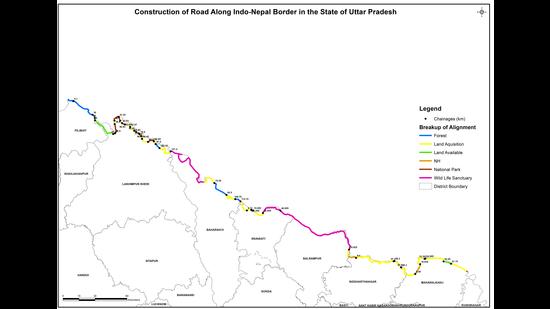
The CAG observed that the ministry of home affairs had approved the INBR project in November 2010 to construct roads of strategic importance along the Indo- Nepal border by March 2016. The SSB was to be benefitted from the project with effective mobility of the troops to dominate the sensitive borders. The UPPWD, the executing agency, was responsible to complete the project in its entirety.
The CAG report on general and social sector for the year ending March 31, 2019, was tabled by UP parliamentary affairs minister Suresh Khanna in the state legislative assembly on August 19.
In Uttar Pradesh, the UPPWD was implementing the project. The initial alignment of 640 km INB road in the state was revised to 574.59 km, including 257.02 km under 12 sanctioned detailed project reports (DPRs), after a survey. The remaining 16 DPRs for 317.57 km road were yet to be sanctioned as of December 2019. During 2012-20 (upto December 2019) , UPPWD incurred an expenditure of ₹834.50 crore on implementation of the project, the CAG report said.
The role of the UPPWD in implementation of the scheme was found to be below par. Even after eight years from the commencement of the project, the DPRs of 56% alignment for the INBR in UP was yet to be approved by central government. The UPPWD had not submitted the revised alignment and forest clearances for these stretches of roads were yet to be obtained, the report added.
{{/usCountry}}The role of the UPPWD in implementation of the scheme was found to be below par. Even after eight years from the commencement of the project, the DPRs of 56% alignment for the INBR in UP was yet to be approved by central government. The UPPWD had not submitted the revised alignment and forest clearances for these stretches of roads were yet to be obtained, the report added.
{{/usCountry}}Even for the 252 km stretches sanctioned by the central government, only 132.64 km (52%) of the sanctioned road length could be completed till December 2019, the CAG observed.
The failure of UPPWD in getting the site cleared for construction coupled with acquisition of land at a snail’s pace and delays in forest clearance caused massive delays of 16 to 66 months beyond the stipulated dates for completion of contracts. This led to 42% increase in the construction cost and 164% increase in cost of land acquisition. The SSB border outposts (BOPs) situated off the constructed roads were left without connectivity despite central government covenants to provide connectivity through link roads.
The CAG noticed that contract management of road construction was opaque and deficient. Financial bids were opened prior to technical sanction. There were inordinate delays in execution of contracts. Execution of the project was marred by delays in recovery of advances and considerable amounts remained pending. Quality control and monitoring were without requisite oversight by the authorities responsible leading to the possibility of sub- standard construction works on a project of strategic importance.
The inadmissible expenditure was incurred from funds provided by the central government due to lack of clarity on the terms and conditions for implementation of the scheme since MoU between the centre and the state government was not finalised, the CAG stated.