
 E-Paper



Beds full, halls packed: The growing crisis in Lucknow’s govt hospitals
The trauma and gynaecology and obstetrics wards of KGMU are most strained for space, with patients and their relatives often sprawled across corridors, department lobbies, and stairwells

 Prefer HTon Google


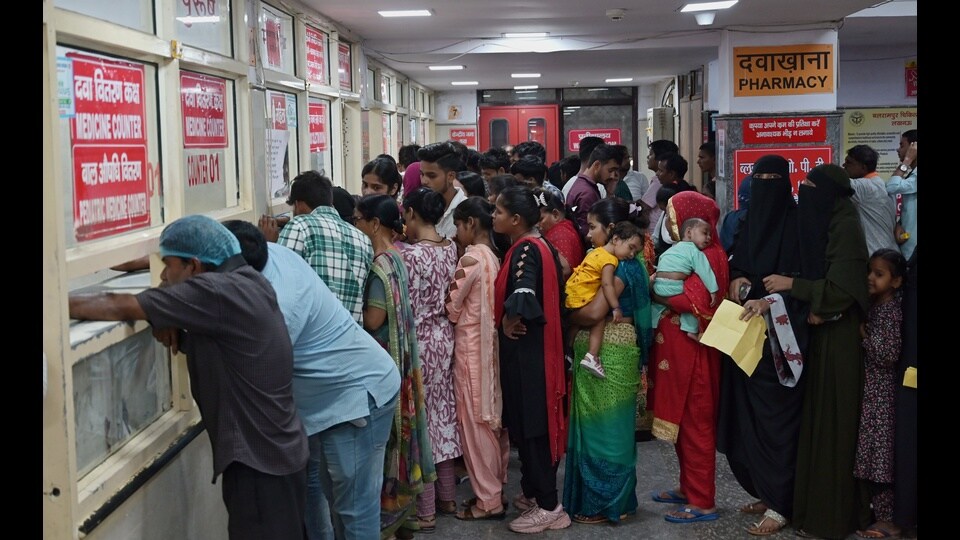
A quick walk through the crowded waiting rooms and wards, along with patients seeking space in the corridors of government hospitals in Lucknow—especially Balrampur Hospital and King George’s Medical University (KGMU)—reflects a severe shortage of beds and waiting areas for patients and their attendants.
The trauma and gynaecology and obstetrics wards of KGMU are most strained for space, with patients and their relatives often sprawled across corridors, department lobbies, and stairwells. The trauma centre, with a capacity of 460 beds, admits nearly 130 patients daily. At any given time, it houses 500 patients and refers at least 50 patients to other hospitals. Similarly, the gynaecology and obstetrics ward, equipped with 340 beds, admits around 50 new patients daily, bringing the number of treated patients to 370-375 at any given time, according to Dr Anju Agarwal, head of the gynaecology department.
“The second-floor staircase landing has been our spot for the past two days,” said Munna Yadav, who, along with his father, is attending to his brother admitted in the Trauma ward. “We must wait for the doctor to make his rounds, and since he is very busy, he often changes the timings. We cannot travel up and down from Alambagh multiple times a day, so we spend the first half of the day in the hospital,” explained Yadav.
With over 4,200 beds across all departments, KGMU sees a daily footfall of 8,000 patients. Several wards are accommodating 12 to 15 extra patients, such as the Paediatrics Department, which fits 40 extra patients in its 71-bed ward almost daily, revealed HoD of Paediatrics, Dr JD Rawat. The hospital sees 560-570 new admissions daily from the OPD and has a surgery waiting list extending up to 2-3 months.
“We are expanding our wards and bed capacity. We’ve recently entered into a contract to build a night shelter with more than double the bed capacity and have been allocated free land by the state to reconstruct certain departments and wards,” shared KGMU vice chancellor Dr Soniya Nityanand.
At Balrampur Hospital, OPD waiting areas are also overcrowded, with patients and attendants in long queues, especially outside the pharmacy. “This is supposed to be one of the bigger government hospitals in Lucknow,” complained Sarita Shukla, who stood in line with her baby. “Yet the process is confusing and chaotic, with patients not following any order, and doctors struggling to manage the crowd.”
“With over 650 beds, we’ve added some in the wards to accommodate more patients, but we still fall short,” said Dr NB Singh, chief medical superintendent of Balrampur Hospital. “At any given time, we have nearly 700 patients admitted, sometimes more. In the Emergency Ward, which has 50 beds, we often treat 5-10% more patients by adjusting space and adding extra beds, especially during the rise in dengue cases.”
“There are patients in need of palliative care whom we must admit. However, patients with chronic illnesses requiring constant medical assistance but no curative treatment are often referred to other hospitals,” added Dr Srivastava.
While KGMU is expanding, Balrampur Hospital is still awaiting approvals for the space and staff recommendations forwarded to the health department to handle its growing footfall.


