E-Paper



Christian graveyards in Lko: Two functional grounds nearly full, where will the dead rest in peace?
Christian Burial Board approaches ASI with Vilayati Bagh site in mind; case rests with protection body

 Prefer HTon Google


The two Christian cemeteries in the state capital — the one in Paper Mill Colony, Nishatganj and the other in Mall Avenue - will soon have no space left to bury the dead. The situation has set alarm bells ringing.
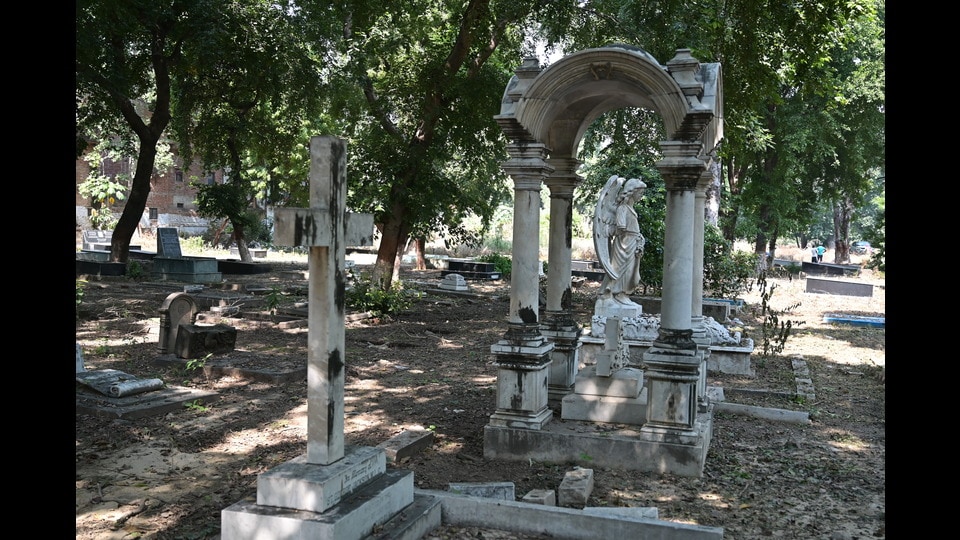
The Nishatganj cemetery dates back to1849 and is spread over 40 bighas of land while the one in Mall Avenue dates back to 1840 and is spread over 24 bighas of land. On an average, about 200 deaths take place in the Christian community in a year.
“There is very little space left in these two cemeteries. Space will be required in the near future,” said Rakesh Kumar Chatree, secretary, Uttar Pradesh Christian Association. The association will hand over a memorandum to Lucknow divisional commissioner, Roshan Jacob, to draw the administration’s attention to the cemetery located at Vilayati Bagh, Dilkusha. It is spread over 12 bighas of land and has three graves. This is Nazul land. This cemetery can be given to the Christians, he said.
Fr Donald D’Souza, spokesperson, Catholic Diocese of Lucknow said, “It is an alarming situation and the government must allocate dedicated land so that Chrisitan community members may carry out dignified last rites of their loved ones.”
In this context, letter number NBG 02-04/20 dated February 23, 2021 sent by the then Lucknow Municipal Corporation confirms that Vilayati Bagh Nazul is registered in Khasra number 30 including Gosha 02 to 09 of Mohalla Dilkusha Ramana. The cemetery in this garden is recorded as British.
“Most of the land covered by the cemetery here is vacant. This 12 bigha land here and three graves,” Chattree said. The UP Christian Association will request the administration to grant permission to use the vacant Nazul land for the cemetery or provide another place, he said.
These two cemeteries are maintained and looked after by the Lucknow Christian Burial Board, an autonomous body to maintain Christian cemeteries in Lucknow and make arrangements for burials.
The cemeteries need financial assistance for their upkeep. The Christian Burial Board has appealed to all Christian families requesting cooperation in the development and progress of both its Nishatganj and Mall Avenue graveyards.
The appeal sent to Christians reads that they should come and clean the graves of their loved ones at least once a month, throw empty packets of candles and incense sticks in the dustbin nearby, if they have extra gravel/sand/cement/colour/paint etc, donate such things which can be used in the graveyard.
The Vilayati Bagh Story
Lucknow Christian Burial Board president JJ Joseph went back in time to narrate the story of Vilayati Bagh.
Nawab Haider Ali had a Christian wife - Mary Short (a Britisher) , whom the locals referred to as Vilayati Begum. Out of love, Haider Ali built a palace for his Christian wife, and because Mary Short used to live there, locals rechristened the palace as Vialayati Bagh Kothi. The palace also employed a healthy number of palace guards for protection.
“When the first war of independence broke out in 1857, all but three of the guards escaped to save their lives and the three left, died fighting to protect Vilayati Bagh Kothi. Dilkusha Kothi suffered damages but Vilayati Bagh Kothi was completely destroyed. The three graves in Vilayati Bagh are of the three faithful soldiers who stayed behind,” said Joseph.
He added that this is not a myth but a plaque in Vilayati Bagh records the developments.
After independence, the Archaeological Society of India took over Vilayati Bagh and all associated land to protect the three graves. It is this land that the Lucknow Christian Burial Board is hoping to acquire so that burial of Christians can go on unhindered.
The Burial Board approached the Lucknow Municipal Corporation (LMC) after the pandemic and after discussions, a possible site was searched for. The search zeroed in on Vilayati Bagh, but because it was ASI-protected, the LNN could do little about it .
However, the then municipal commissioner, wrote a letter to the ASI, Lucknow, on June 26, 2021, requesting it to do all in its power to help the Christian community
In October, 2021, Joseph met with ASI officials at the Aliganj office, where he was told that permission could be granted but there could be no “permanent constructions (pukka graves)” on the land. He was also told that ASI, Lucknow, would have to take permission from Delhi for the plan to move forward.
Earlier this year, the ASI was approached again to know the progress in the case. There has been no progress yet.