
Bringing the centuries-old cultural traditions of Odisha’s Particularly Vulnerable Tribal Group (PVTG) to the capital, artists from the Bonda tribe showcased their folk performance at the Deshaj Cultural Festival, organised at Muktikashi Manch in Ram Manohar Lohia Park on Saturday.
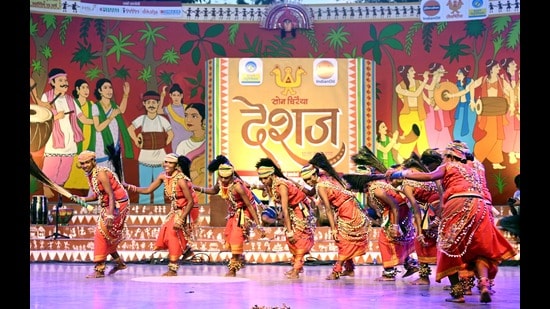
Accompanied by retired judicial officer Pratima Rath, the troupe offered a rare glimpse into the Bonda community, which is gradually finding a place on national platforms while remaining deeply rooted in its ancestral heritage. For decades, the community, with an estimated population of 4,000-5,000 spread across 25 remote hilltop villages, each comprising small clusters of 13 to 50 households, remained largely isolated from the mainstream.
“The community’s traditional dances and folk songs were largely restricted to local seasonal celebrations such as Chaita Parab, Jait Parab and Dussehra Parab. Although elders were familiar with these art forms, venturing beyond their hills was once unthinkable. Even today, outsiders face strict restrictions on entering their villages, as the community’s distinctive traditional attire and dressing practices can make them vulnerable to sexual, physical and other forms of exploitation,” said Rath.
The initiative to bring these traditions to public platforms began with an NGO founded by Rath’s late husband to support eight marginalised tribes in Odisha through cultural preservation and development. After his death in 2020 and her retirement as a judicial officer in 2023, Rath took the initiative forward.
{{/usCountry}}The initiative to bring these traditions to public platforms began with an NGO founded by Rath’s late husband to support eight marginalised tribes in Odisha through cultural preservation and development. After his death in 2020 and her retirement as a judicial officer in 2023, Rath took the initiative forward.
{{/usCountry}}During her visits to the Bonda hill villages, spread within a 40-km radius, Rath initially encountered hesitation among villagers reluctant to venture outside. She then focused on mentoring young artists, preparing them to showcase their cultural heritage on national platforms, eventually earning invitations from across the country.
“The Bonda artists have a distinctive visual identity. Traditionally, Bonda women did not wear stitched upper garments but adorned themselves with layers of heavy, generationally inherited jewellery and a traditional woven cloth called the ringa, while men wear the jingjunglu. During performances, the women wear sarees, glass-bead necklaces (mala) and heavy brass ghunghroos, carrying up to 28 kg of traditional silver, glass and shell ornaments. These heirlooms, valued at nearly ₹85,000, make them a rare sight even in Odisha,” Rath said.
Sukri Sisa, 22, is among the first generation in her family to graduate from college after studying at a free government residential school. Initially hesitant, she was inspired by Rath to explore the world beyond her hills. Having performed in Delhi four times, she says audiences are curious about her roots. “Our culture is rich, and while we want to keep pace with the modern world, we need sustained institutional and social support to preserve and promote our traditions,” Sisa said.
Jhunu Dhangada Majhi, 28, described her journey as one of perseverance and transformation. Growing up in a community with limited basic facilities and dependent on subsistence farming of millets such as ragi, sua and kangu, she financed her graduation through manual labour, while seeing her elder sisters marry early. Today, cultural tours and handicraft initiatives have opened up new livelihood opportunities. Efforts are also underway to turn traditional craftsmanship into a sustainable source of income, she said.
Other performances included the Naktaura of Awadh, Nautanki in the style of Gulabbai, and Dahiwali and Aalha by Sanju Baghel.
ABOUT THE AUTHOR
Godhooli Sharma is working as Senior Content Creator and is based in Lucknow. She majorly covers Education and Science beats alongside cultural and human-interest stories. If not in office, she can be found wandering in quest of news stories - driving from one end of the city to another until dusk just to file the stories in time. She has over four years of experience in the field of journalism and was previously with The Times of India. A fast learner, hard worker and multitasker who rises up with the zeal to get on a whole new expedition of learning. She goes by believing that coming into this profession was by her choice and not by chance - generally considered the other way around for journalists. Outside of journalism, she is engaged in creative pursuits, including photography, painting, bird-watching and travel. Being a creative person inside out, she believes in pulling out some soft stories that can bring cheer to society. Her reporting frequently features stories on scientific innovations, academic issues across Lucknow University and local schools, student achievements under adverse circumstances, and local cultural affairs like the city's theatre scene. Born and raised in Indore, she completed his intermediate and later her higher education from Isabella Thoburn College and Lucknow University respectively.