LUCKNOW Despite a halt in local rainfall, a massive influx of water from upstream catchment areas pushed the Gomti river nearly eight feet above its normal level on Friday, submerging the iconic Gomti Riverfront and forcing authorities to open all 10 barrage gates. The expanding river has swallowed large, low-lying sections of the riverfront, prompting officials to close the area to the public indefinitely.
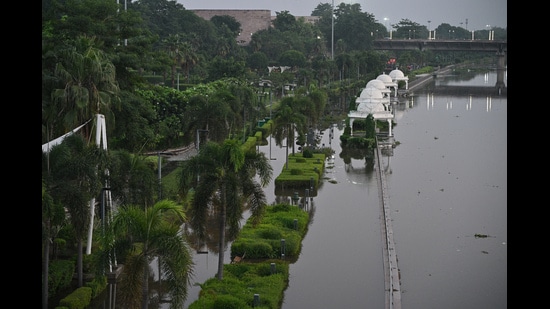
The river surged to 108.14 metres — well beyond its normal 105.70-metre mark — driven by heavy runoff from neighboring Lakhimpur Kheri, Pilibhit and Sitapur districts, said officials.
As part of measures to prevent urban flooding, the irrigation department sealed 48 city drainage outlets to stop the swollen river from backing up into Lucknow’s drainage network.
Irrigation department executive engineer (Lucknow division) Mukesh Vaish said the normal water level of the Gomti is maintained at around 105.70 metres. The current level of 108.14 metres is therefore 2.44 metres—nearly eight feet — above normal.
“Water coming from the upstream catchment areas has started reaching Lucknow, resulting in the rise in the Gomti’s water level,” he said.
He said the rise was not primarily due to fresh rainfall in Lucknow, but the downstream movement of water generated by heavy rain in areas upstream of the city. As the accumulated runoff reaches Lucknow, it is adding to the river’s discharge and raising its level.
{{/usCountry}}He said the rise was not primarily due to fresh rainfall in Lucknow, but the downstream movement of water generated by heavy rain in areas upstream of the city. As the accumulated runoff reaches Lucknow, it is adding to the river’s discharge and raising its level.
{{/usCountry}}With the river level high, the irrigation department opened all 10 gates of the Gomti barrage to facilitate the movement of water downstream.
Vaish said the gates are operated according to the river’s water level and flow conditions. During a rise in the river, opening the gates helps water pass downstream and reduces the possibility of it backing up upstream towards the city.
The barrage also plays a role in regulating the river level and supports infrastructure associated with the city’s water supply.
The impact of the rising river was clearly visible at the Gomti Riverfront, where water had spread over large sections of the normally accessible area. With the river expanding beyond its usual channel, several low-lying portions of the riverfront have been submerged.
Vaish said around 48 drainage outlets, or barrels, connected to the Gomti had also been closed following the rise in the river level.
These outlets provide a route for the city’s drainage network to discharge into the river. Their operation is regulated during high river levels to prevent the swollen Gomti from backing up into the drainage system.
The irrigation department is monitoring the river level and downstream movement of water, officials said.
The department expects the Gomti’s water level to start declining from Monday, if the inflow from upstream catchment areas reduces.
Vaish said the department was closely monitoring the situation and would regulate the barrage gates according to the river’s level and flow conditions.