LUCKNOW: The new colour of the refurbished Rumi Gate in the Old City, thrown open to the public on Thursday after two years, has not gone down well with heritage lovers. According to them, the new pinkish colour is not only strange but very different from the monument’s original colour before restoration. They now plan to take up the matter with the divisional commissioner as well as the Archeological Survey of India (ASI) which undertook the restoration work.
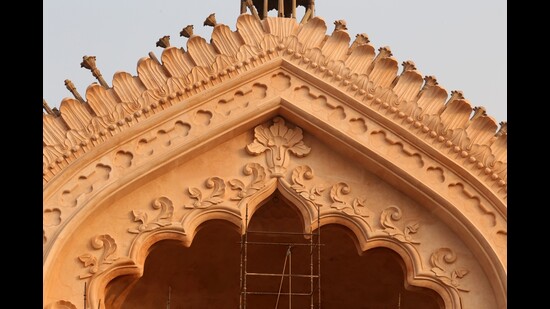
“On Saturday, we went to inspect the repair of Rumi Gate which was opened after two years for the Shahi Zari procession of the first of Moharram. We observed that the floral spokes on top of Rumi Gate were missing and the entire colour was pinkish (like pink stone ) which did not appeal to the eye,” said Nawab Masood Abdullah of the Old City.
“The Bada Imambada is painted in a different hue, more of a yellowish brown tint which was spray painted during the G20 summit a year ago. Two different and mismatched colours of Bada Imambada and Rumi Gate which are in the same vicinity seem odd,” he said .
Historian and scientist P C Sarkar said, “Our refurbished monuments, including the Residency cemetery, now sport a strange pink or yellow hue. The refurbishing destroyed these structures’ vintage appearance. We understand the repairing and strengthening. But the strange hues are beyond comprehension.” Sarkar also shared some vintage pictures of the the 80-foot-high edifice, built in 1784 by Nawab Asaf-Ud-Daula, for comparison.
City-based heritage expert Nishant Upadhyay suggested that there were methods through which one could try to replicate a slightly older look/patina on the monument while undertaking conservation . “One can feel the difference of shades on left and right,” he said. Upadhyay said that whenever ASI added new elements, they made sure to somehow distinguish them from the original elements, as per the ICOMOS Venice Charter of 1964 which was followed as a guidebook globally for architectural conservation till now.
{{/usCountry}}City-based heritage expert Nishant Upadhyay suggested that there were methods through which one could try to replicate a slightly older look/patina on the monument while undertaking conservation . “One can feel the difference of shades on left and right,” he said. Upadhyay said that whenever ASI added new elements, they made sure to somehow distinguish them from the original elements, as per the ICOMOS Venice Charter of 1964 which was followed as a guidebook globally for architectural conservation till now.
{{/usCountry}}The charter says to keep the new restoration works distinguishable from original elements but keeping alive the spirit of the monument.
“Restoration is not reconstruction. Purists would not reconstruct any architectural element lost in time. Worse, the colour of the Bada Imambara doesn’t match the Rumi Darwaza,” said Mohit Bhargava.
“Architectural plagiarism! It’s rather distressing to have to witness jewels of heritage handled this way!,” added another heritage lover Molshri.
Traditional methods followed
However, some heritage lovers feel that the conservation work done by ASI is good and the colour will take emerge better in time.
According to filmmaker Iqbal Kidwai, when the ASI gets down to it, they do use traditional construction methods and artisans. Most of the time the restoration work is quite good. The years of work at Agra Fort and the Taj Mahal undertaken by the ASI were quite good, he said. “Look at the bright side, materials used in the Rumi Darwaza are the same as when it was constructed. No cement and concrete. Perhaps the surkhi - chuna combo with other elements has not come out in perfect hue. Over time and with age it will acquire the right patina. Patina is good for conservation of copper and metal domes like in European churches but plaster needs to be scraped to be rejuvenated and the new coat allowed time to acquire an aged patina. It will be impossible to fill cracks and strengthen the exterior walls without a new coat of plaster and pigment. So give it time and bless the ASI for doing whatever they are doing,” he informed.
Colour not artificial: ASI
According to ASI, the new colour is not artificial, but the hue of ‘surki’ mortar, which is finally powdered burnt clay. Free of any admixture or impurities, it provides strength and is also cheaply available in the market. The ASI relied almost exclusively on traditional methods and used basic home material like pulses, jaggery and eggs, among others, to make lime mortar.