The three-day ‘Know Your Army’ festival that concluded at the Surya Khel Parisar in the Lucknow Cantonment on Sunday attracted people, introducing them to modern weapon systems as well as those associated with famous victories like the Kargil war against Pakistan.
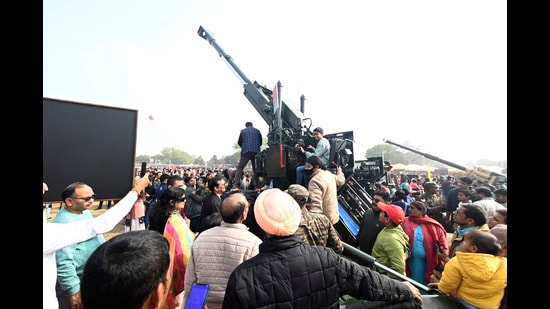
Defence PRO, Dehradun, Manish Srivastava explained the history behind some major weapon systems on display at the unique exhibition.
Srivastava explained that the K-9 Vajra artillery propellor, that was on display at the festival is latest to be inducted into the Indian artillery regiment and boasts of excellent firing mechanism and advanced fire control system.
“Ideal for use in desert terrains, it can also be used in high altitudes with certain limitations. Few of these have been used in high altitudes in Jammu, Kashmir too,” he said.
The Bofors artillery guns that proved their importance during the Kargil war that India won against Pakistan, were displayed too. “This artillery gun, now being used by one of the artillery units of the 14 Infantry Division is different from K-9 as it has to be towed by field artillery tractors, has an auxiliary engine with which it can move short distances,” Srivastava explained.
He also explained about T-90 - the Indian army’s main battle bank, which is sourced from Russia. “This is the latest version the army has upgraded to, with better range, fire control and mobility, including night firing capability. An extremely agile, flexible and potent fighting machine it is the only tank with a barrel and can fire a missile,” he said.
{{/usCountry}}He also explained about T-90 - the Indian army’s main battle bank, which is sourced from Russia. “This is the latest version the army has upgraded to, with better range, fire control and mobility, including night firing capability. An extremely agile, flexible and potent fighting machine it is the only tank with a barrel and can fire a missile,” he said.
{{/usCountry}}Srivastava spoke highly of the indigenously developed Swathi weapon locating radar, that picks up and identifies the location and type of battery and weapon, enabling the home army to initiate counter-bombardment.
“These kinds of radars can locate multiple gun positions simultaneously. This particular weapon is able to store and prioritise 99 targets simultaneously, and has a maximum range of 48 kilometres,” Srivastava said.