As Durga Puja began on Sunday, Lucknow’s pandals are nearing completion, each taking shape as a world of its own, where history, art and architecture come together to tell stories that go beyond festive spectacle.
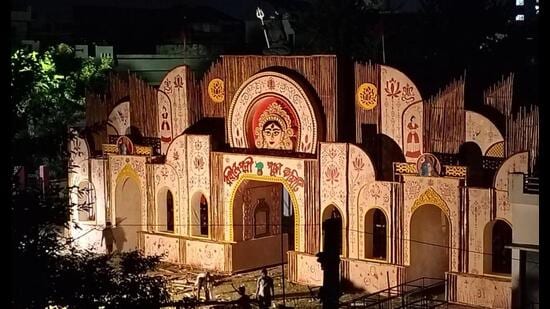
This year, several committees are delving into Bengal’s cultural memory recreating the courtyards of aristocratic Kolkata families, drawing on folk art traditions and bringing alive architectural landmarks associated with the state.
At Latouche Road, the idea is rooted in history with Zamindar style puja. “The Latouche Road Puja Sangsad Society is recreating the Thakur Dalan of a Bonedi Bari of Kolkata, the courtyard inside the mansion of an influential family traditionally used for family and religious gatherings. The installation will draw from the tradition of prominent private family Durga Pujas that have continued for 100 to 300 years,” said society’s president SK Banerjee.
“The recreation is not limited to the architecture. Goddess Durga and her family will be dressed in a complete set of gold-plated jewellery specially crafted by artisans from West Bengal, adding another layer of authenticity to the recreation of an old Kolkata household puja,” said society’s general secretary Niloy Sen.
“The choice of a Thakur Dalan is significant because these courtyards were historically at the heart of Durga Puja in the homes of Bengal’s old landed and influential families. Rather than constructing simply a façade, the committee is attempting to recreate the setting in which a family’s centuries-old religious tradition would have unfolded,” Benerjee added.
{{/usCountry}}“The choice of a Thakur Dalan is significant because these courtyards were historically at the heart of Durga Puja in the homes of Bengal’s old landed and influential families. Rather than constructing simply a façade, the committee is attempting to recreate the setting in which a family’s centuries-old religious tradition would have unfolded,” Benerjee added.
{{/usCountry}}In another part of the city, the connection with Bengal is being explored through its folk art tradition. Sadbhavna Sanskritik Samiti in Sahara States, Jankipuram, has chosen “Lok Chitra” as its theme.
“The pandal will take the form of a terracotta village temple and will feature art inspired by the works of Bengali artist Jamini Roy, whose visual language drew heavily from Bengal’s folk traditions,” said its president Ran Avatar Pandey.
At Rabindra Palli, the theme “Chironton Bangla” similarly looks towards traditional Bengali life, with a village setting and Goddess Durga portrayed as an ordinary Bengali household woman rather than an elaborately adorned royal figure. “The puja is being organised entirely by women members of the colony,” its media coordinator Shefali Devanshu Choudhary said.
Shashwat Durga Puja Samiti in Vikas Nagar is taking visitors towards another part of Bengal’s cultural landscape drawing inspiration from the architecture of Kolkata’s Dakshineswar Kali Temple, including its distinctive towers, pillars and detailing, says samiti’s secretary Sumit Bhowmick.
At Ansal, this year’s pandal will take visitors into the world of Bahubali, continuing the city’s tradition of using large-scale visual storytelling to transform temporary puja structures into attractions in their own right.
Several of these elaborate installations are being created by Lucknow-based artist Asim Matiya who has become closely associated with the city’s large-scale Durga Puja pandal designs.