...
...
Next Story

Private agri tubewells guzzle over 20% of UP’s power

But the contribution of agricultural pump sets to UP Power Corporation Ltd’s (UPPCL) revenue is significantly lower at just a little more than 9%

Published on: Mar 8, 2024, 21:35:06 IST
Advertisement

LUCKNOW Over 20% of Uttar Pradesh’s electricity is consumed exclusively by private agricultural tubewells, surpassing industries, and ranking as the second-biggest power guzzler after the domestic sector in the state.
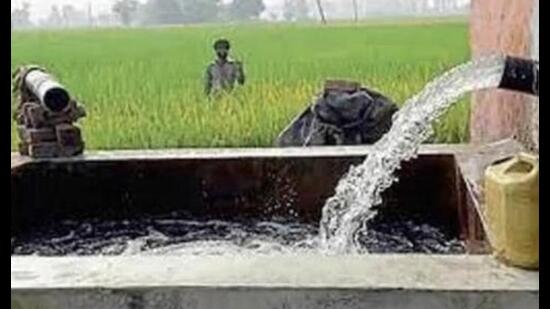
‘The Statics at a Glance: 2021-22’, a publication brought out annually by the UPPCL, put private tubewells’ total share in the energy consumption in the state at 20.20% during the year. This rivalled the combined consumption of all industries and institutions, which together consumed only 20.30%. (Pic for representation)

But the contribution of agricultural pump sets to UP Power Corporation Ltd’s (UPPCL) revenue is significantly lower at just a little more than 9%.

‘The Statics at a Glance: 2021-22’, a publication brought out annually by the UPPCL, put private tubewells’ total share in the energy consumption in the state at 20.20% during the year. This rivalled the combined consumption of all industries and institutions, which together consumed only 20.30%.

As per the report, around 14.60 lakh private tubewells in UP consumed as many as more than 18942 million units (MU) of power during 2021-22, their share in the total power sold by the UPPCL being 20.20%.

Industrial consumers, on the other hand, were sold only 18028 MU power and their share in the total power consumption at 19.23% was below that of farm tubewells.

Not only did tubewells have a greater share in the state’s total power consumption, but they also boasted connected load of 9381371kw, which was more than the 9108572kw power load of all industries put together.

However, the private tubewells’ share in the total revenue earned by the UPPCL was disproportionately lower at just 9.05% against 29.42% of industries. While the per unit realization from industries was 9.18, it was just 2.60 from agricultural consumers despite subsidy by the state government.

It may be pointed out here that officially, rural feeders in UP get only 18 hours of power a day and private tubewells operate only for 120 days a year during agriculture season, unlike industries that operate round the year.

A former UP Electricity Regulatory Commission (UPERC) chairman said the share of private tubewells in the total power consumption in the state is gradually increasing.

“The lifting of ban on new power connection in the state’s dark zones in 2020 and depleting groundwater in most districts, requiring farmers to install tubewells of higher capacity are also contributing to more energy usage by agricultural consumers in the state,” he said.

NO. OF PVT FARM TUBEWELLS IN U.P.

Discom No of PTWs (in lakh)

Meerut 4.97

Agra 3.12

Varanasi 3.66

Lucknow 2.85

Total 14.61

 
ABOUT THE AUTHOR
Brajendra K Parashar

Brajendra K Parashar is a Senior Journalist with the Hindustan Times, based in Lucknow, with nearly three decades of experience covering governance, public policy, politics and development in Uttar Pradesh. Over the years, he has reported extensively on key sectors, including energy and renewable power, mobility and transport, road safety, agriculture and allied sectors and issues related to farmers, rural development, taxation under the Goods and Services Tax (GST) and public administration. A seasoned political correspondent, Parashar closely tracks the Bharatiya Janata Party (BJP) and has covered every major election in Uttar Pradesh right from three-tier panchayat elections and urban local body polls to Assembly and Lok Sabha elections. He also reports regularly on the proceedings of the Uttar Pradesh Legislature, bureaucracy, governance, policy decisions and administrative developments with focus on their impact on public life. His reporting is known for its strong analytical approach, extensive use of official data. His areas of interests include investigative journalism, long-form political and policy analysis, data-driven reporting, elections and institutional reforms. Parashar holds a postgraduate degree in Political Science with First Division from Aligarh Muslim University (AMU), followed by a Diploma in Journalism and Mass Communication from the same university. His inclination towards journalism began during his student days, when he regularly contributed letters to editors and articles to newspapers and magazines. In the mid-1990S, his essay, “Should India Switch Over to the Presidential Form Of Government?”, published in Politics India magazine edited by noted constitutional expert Subhash C Kashyap, was adjudged the best entry in a national competition. His work has received professional recognition, including the Hindustan Times Journalist of the Month Award for an impactful series on drinking water issues during the 2010 Lok Sabha election campaign. Originally from Kasganj in western Uttar Pradesh, Parashar is currently based in Lucknow where continues to report on politics, governance and public policy.

SHARE THIS ARTICLE ON
Notifications

Get breaking alerts directly from the newsroom

Notifications are on!You'll be notified when news breaks